


Did you know?
Sunburn – Did you know that worker exposure to UV radiation from the sun must be limited? Employees are required to report a sunburn to their supervisor or employer, just like any other type of workplace injury.
Welding screening – Did you know that if people are not prevented from entering a workplace with welding operations, screening may be necessary to reduce exposure to radiation and reflection?
Diving operations – Did you know that divers and atmospheric diving system (ADS) operators need to be protected from radiation emitted from devices?
Summary
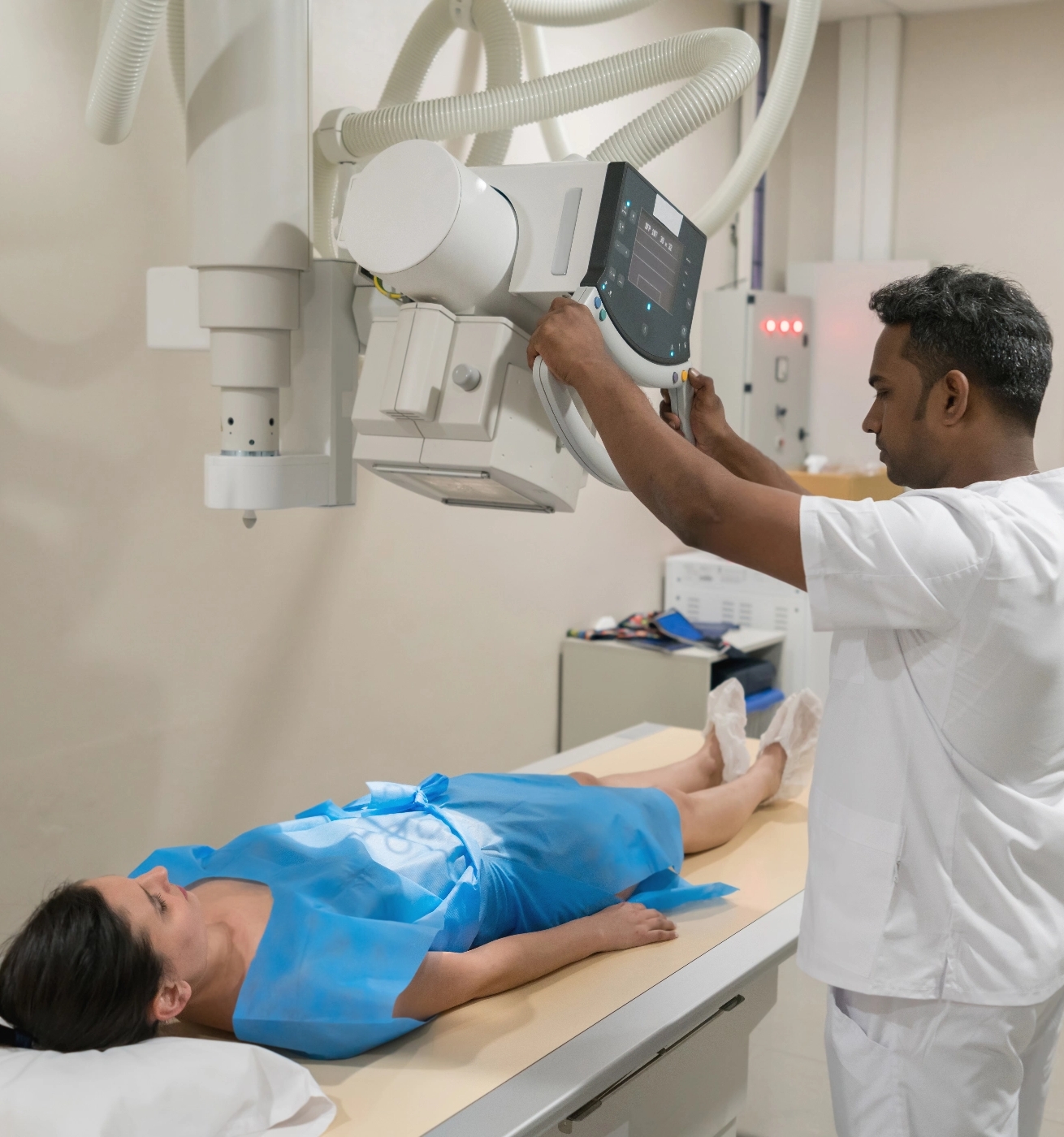
Radiation is a form of energy that could be harmful to a worker's health. It can be separated into two main types: ionizing and non-ionizing. Ionizing radiation is higher energy and generally requires greater control measures. An example of a workplace where exposure to ionizing radiation may occur is a clinic where X-rays are used for medical imaging. Non-ionizing radiation is also a health and safety hazard that must be controlled. Exposure to UV light from the sun is a common source of workplace exposure to non-ionizing radiation that must be limited to prevent sunburn, eye damage, and skin cancer.
An employer must:
- Take all reasonable precautions under the circumstances to protect the health and safety of workers and that of other persons at or near the workplace. [S.N.S. 1996, c.7, s. 13(1)]
- Provide information, training, supervision and facilities that are needed, and ensure that the employees, supervisors, and foremen are familiar with the health or safety hazards that may be present at the workplace. This duty applies to all types of radiation. [S.N.S. 1996, c.7, s. 13(1)]
- Provide and maintain equipment, machines, materials or things that are properly equipped with safety devices, and ensure that the employees are made familiar with the proper use of all devices, equipment and clothing required for their protection [S.N.S. 1996, c.7, s. 13(1)]
- Where a person is exposed to a hazard that may irritate or injure the eyes, face, or front of the neck, make sure that adequate protection is worn or used that complies with CSA standard CSA Z94.3 “Industrial Eye and Face Protectors.” [N.S. Reg. 44/99, s. 10(1)]
- Where a person is exposed to a hazard that may injure the skin, make sure adequate protection is worn or used. [N.S. Reg. 44/99, s. 12(2)]
An employee must:
- While at work, take every reasonable precaution in the circumstances to protect the employee’s own health and safety and that of other persons at or near the workplace [S.N.S. 1996, c.7, s. 17(1)(a)].
- Take every reasonable precaution in the circumstances to ensure that protective devices, equipment or clothing required by the employer are used or worn [S.N.S. 1996, c.7, s. 17(1)(c)]
- Report to a supervisor any condition, device, equipment, machine, material, thing or any aspect of the workplace that is or may be dangerous to the employee’s health or safety or that of any other person at the workplace [S.N.S. 1996, c.7, s. 17(2)].
- Use or wear all required personal protective equipment, including respiratory protection, according to the instructions and training. [N.S. Reg. 44/99, s. 9A]
- Notify the employer of any damaged personal protective equipment. [S.N.S. 1996, c. 7, s. 17]
Threshold Limit Values for Ionizing Radiation
An employer must:
- Ensure that workers are not exposed to a dose limit that exceeds the Threshold Limit Value (TLV®). For ionizing radiation, the following limits apply : [N.S. Reg. 52/2013, s. 2.1] [N.S. Reg. 52/2013, s. 2.3]
- Annual dose, 18 years of age and older: should not exceed 50 mSv (units of millisievert (Sv)).
- Cumulative dose, 18 years of age and older: should not exceed 10 mSv times current age in years.
- Embryo-fetus of pregnant worker following declaration of pregnancy: should not exceed 0.5 mSv per month (equivalent dose in the embryo-fetus).
- Lens of the eye: Should not exceed 50 mGy per year in the lens of the eye (units of milligray (Gy)).
- Skin, hands, and feet: Should not exceed 500 mGy in skin or extremities per year, averaged over the most highly exposed 10 cm2 of skin.
However, Threshold Limit Values (TLV®s) should not be viewed as a fine line between safe and unsafe worker exposures. Employers should strive to keep workers' exposure to ionizing radiation as low as possible.
Underwater Diving
- An employer must: Protect the health and safety of a worker who is a diver or atmospheric diving system (ADS) operator who may be exposed to electromagnetic or ionizing radiation emitted from a device. [N.S. Reg. 174/2005, s. 76]
Blasting Activity
An employer must:
- Make sure that workers performing electric blasting maintain a minimum distance from radio frequency transmitters as detailed in the Institute of Makers of Explosives Safety Guide for the Prevention of Radio Frequency Radiation Hazards in the Use of Commercial Electric Detonators (Blasting Caps) Safety Library Publication No. 20, 2001, as amended. [N.S. Reg. 89/2008, s. 76(1)] [N.S. Reg. 296/2008, s. 500(1)]
- If a minimum distance has not otherwise been determined, ensure that the following minimum distance requirements are maintained between electric blasting circuits and the following radio frequency transmitters to avoid unintentional detonation of explosives due to radio frequency interference in blasting operations:
- Citizens' band radio, cellular telephone, satellite telephone or other mobile or portable radio frequency transmitter: 100 metres minimum distance.
- TV transmitter or an AM, FM or other radio frequency transmitter: 1000 metres minimum distance. [N.S. Reg. 89/2008, s. 76(2)] [N.S. Reg. 296/2008, s. 500(2)]
An employee must:
- Maintain a minimum distance from radio frequency transmitters as detailed in the Institute of Makers of Explosives Safety Guide for the Prevention of Radio Frequency Radiation Hazards in the Use of Commercial Electric Detonators (Blasting Caps) Safety Library Publication No. 20, 2001, as amended, when performing electric blasting. [N.S. Reg. 89/2008, s. 76(1)] [N.S. Reg. 296/2008, s. 500(1)]
- Follow the accepted minimum distance requirements between electric blasting circuits and radio frequency transmitters. [N.S. Reg. 89/2008, s. 76(2)] [N.S. Reg. 296/2008, s. 500(2)]
Electric Arc Welding and Cutting
An employer must:
- Provide adequate screening during welding or a similar radiation-producing process that prevents any person at or near the workplace from being excessively exposed to radiation and reflection. Otherwise, prevent people from entering the work area to reduce or eliminate their exposure. [N.S. Reg. 44/99, s. 112]
Ultraviolet (UV) Radiation
Ultraviolet (UV) radiation exposure can cause sunburn, eye irritation, skin cancer, and blindness. UV radiation comes from many sources, but the sun is the source that affects the most people. Outdoor workers in Nova Scotia are at risk of developing skin cancer from overexposure to UV radiation. Welding arcs, tanning beds, certain LED lights for growing plants, and water filtration systems are also common sources. Other factors that contribute to exposure include:
- Contact with coal tar, pitch, asphalt, creosote, paraffin wax, petroleum products, and arsenic.
- Reflections off glass, snow, water, sand, and concrete.
- Exposure to photosensitizing chemicals and medications.
Steps that can be taken to reduce exposure include:
- Work under a shade shelter.
- Substitute photosensitizing chemicals.
- Whenever possible, schedule outdoor work to occur before 11 am and after 3 pm during the summer.
- Modify reflective surfaces.
- Work when the UV index is below 3.
- Wear suitable clothing, head, and neck coverings.
- Wear sunscreen and lip balm with sun protection factor (SPF) greater than 30.
- Wear eye protection for UVA and UVB.
The employer must
- Where a person is exposed to a hazard that may injure the skin, make sure adequate protection is worn or used. [N.S. Reg. 44/99, s. 12(2)]
Lasers
The term "laser" is an acronym that stands for "Light Amplification by Stimulated Emission of Radiation." Laser light is a form of non-ionizing radiation. Laser equipment produces and amplifies light that has unique properties that cannot be produced any other way.
There are two types of laser hazards: laser beam hazards and non-beam hazards. Laser beam hazards include eye and skin burns which are due to laser beam shining on a person's body. Non-beam hazards are associated with the laser equipment or the hazardous substances released from the laser equipment, and fumes emitted from materials exposed to laser beams, including laser plumes produced during surgical procedures.
The employer must
- Ensure that workers are not exposed to laser radiation that exceeds the Threshold Limit Values (TLV®). [N.S. Reg. 52/2013, s. 2.1] [N.S. Reg. 52/2013, s. 2.3]
- Threshold Limit Values (TLVs®) are for exposure to laser radiation under conditions to which it is believed that nearly all healthy workers may be repeatedly exposed, without adverse health effects. However, Threshold Limit Values (TLV®s) should not be viewed as a fine line between safe and dangerous levels.[N.S. Reg. 52/2013, s. 2.1]
Please see the topic Personal Protective Equipment for general information.
Legislation
OCCUPATIONAL HEALTH AND SAFETY ACT
S.N.S. 1996, c. 7
Section 13 DUTIES AND PRECAUTIONS
13. (1) Every employer shall take every precaution that is reasonable in the circumstances to
(a) ensure the health and safety of persons at or near the workplace;
(b) provide and maintain equipment, machines, materials or things that are properly equipped with safety devices;
(c) provide such information, instruction, training, supervision and facilities as are necessary to the health or safety of the employees;
(d) ensure that the employees, and particularly the supervisors and foremen, are made familiar with any health or safety hazards that may be met by them at the workplace;
(e) ensure that the employees are made familiar with the proper use of all devices, equipment and clothing required for their protection; and
(f) conduct the employer's undertaking so that employees are not exposed to health or safety hazards as a result of the undertaking.
(2) Every employer shall
(a) consult and co-operate with the joint occupational health and safety committee, where such a committee has been established at the workplace, or the health and safety representative, where one has been selected at the workplace;
(b) co-operate with any person performing a duty imposed or exercising a power conferred by this Act or the regulations;
(c) provide such additional training of committee members or the representative as may be prescribed by the regulations;
(d) comply with this Act and the regulations and ensure that employees at the workplace comply with this Act and the regulations; and
(e) where an occupational health and safety policy or occupational health and safety program is required pursuant to this Act or the regulations, establish the policy or program.
(3) The employer at a subsea coal mine shall provide such additional resources or information for the committee as may be prescribed by the regulations.
(4) Every employer shall, in accordance with the regulations, establish and implement a policy respecting the prevention of harassment in the workplace.
[N.S. 2007, c. 14, s. 7; 2010, c. 66, s. 5; 2024, c. 10, s. 13]
Section 17
17. (1) Every employee, while at work, shall
(a) take every reasonable precaution in the circumstances to protect the employee's own health and safety and that of other persons at or near the workplace;
(b) co-operate with the employer and with the employee's fellow employees to protect the employee's own health and safety and that of other persons at or near the workplace;
(c) take every reasonable precaution in the circumstances to ensure that protective devices, equipment or clothing required by the employer, this Act or the regulations are used or worn;
(d) consult and co-operate with the joint occupational health and safety committee, where such a committee has been established at the workplace, or the health and safety representative, where one has been selected at the workplace;
(e) co-operate with any person performing a duty or exercising a power conferred by this Act or the regulations; and
(f) comply with this Act and the regulations.
(2) Where an employee believes that any condition, device, equipment, machine, material or thing or any aspect of the workplace is or may be dangerous to the employee's health or safety or that of any other person at the workplace, the employee shall
(a) immediately report it to a supervisor;
(b) where the matter is not remedied to the employee's satisfaction, report it to the committee or the representative, if any; and
(c) where the matter is not remedied to the employee's satisfaction after the employee reports in accordance with clauses (a) and (b), report it to the Division.
Blasting Safety Regulations
N.S. Reg. 89/2008
Section 76 Minimum distances from radio frequency transmitters
76. (1) During electric blasting, an employer and a blaster must ensure minimum distances from radio frequency transmitters are maintained as detailed in the Institute of Makers of Explosives Safety Guide for the Prevention of Radio Frequency Radiation Hazards in the Use of Commercial Electric Detonators (Blasting Caps) Safety Library Publication No. 20, 2001, as amended.
(2) If the required minimum distance of electric blasting circuits from radio frequency transmitters has not otherwise been determined, the following minimum distances must be maintained:
(a) 100 m from a citizens' band radio, cellular telephone, satellite telephone or other mobile or portable radio frequency transmitter; and
(b) 1000 m from a TV transmitter or an AM, FM or other radio frequency transmitter.
Occupational Safety General Regulations
N.S. Reg. 44/99
Part 3 Personal Protective Equipment
Section 9A
9A An employee shall wear or use personal protective equipment or devices as required under clause 9(2)(b).
[N.S. Reg. 52/2000, s. 4]
Section 10 Hazard to eyes, face or neck
10. (1) Where a person is exposed to a hazard that may irritate or injure the eyes, face, or front of the neck, an employer shall ensure that protective equipment is worn that is appropriate to the hazard and that complies with CSA standard CSA Z94.3 , "Industrial Eye and Face Protectors".
(2) Subsection (1) does not apply if a person operating a chain saw is wearing adequate face protection as a substitute for the protective equipment referred to in subsection (1).
[N.S. Reg. 52/2000, s. 5; 53/2013, s. 8]
Section 12 Hazard to foot or skin
12. (1) Where a person is exposed to a hazard that may injure the person's foot, an employer shall ensure that protective equipment is worn that is appropriate to the hazard and that complies with the latest version of CSA standard CSA Z195 , "Protective Footwear".
(2) Where a person is exposed to a hazard that may injure the skin, an employer shall ensure that adequate protection is worn or used.
[N.S. Reg. 53/2013, s. 10]
Part 10 Welding, Cutting, Burning and Soldering
Section 112
112. (1) Except where an employer has demonstrated that a person at or near a welding or allied process is not excessively exposed to radiation or reflection, the employer shall provide adequate screens or prevent a person from entering the work area.
(2) Where screening is used in accordance with subsection. (1), the employer shall ensure that the screening is adequate to prevent radiation and reflection from affecting a person at or near the workplace.
Workplace Health and Safety Regulations
N.S. Reg. 52/2013
Part 2 OCCUPATIONAL HEALTH
Section 2.1 Definitions for Part 2
2.1 In this Part,
"physical agent", in relation to threshold limit values for occupational exposure, means an agent of acoustic, electromagnetic, ergonomic, mechanical or thermal nature;
"threshold limit values" means the threshold limit values established by the TLVs and BEIs that represent
(i) for chemical substances, the airborne concentrations of chemical substances and conditions under which it is believed that nearly all healthy workers may be repeatedly exposed, day after day, over a working lifetime, without adverse health effects,
(ii) for physical agents, the levels of exposure and conditions under which it is believed that nearly all healthy workers may be repeatedly exposed, day after day, without adverse health effects,
"TLVs and BEIs" means the latest version of the publication of the American Conference of Governmental Industrial Hygienists of threshold limit values and biological exposure indices.
Section 2.3 Threshold limit values
2.3 An employer must comply with, and ensure compliance with, the threshold limit values for exposure to all of the following, as listed in the TLVs and BEIs:
(a) gases;
(b) vapours;
(c) mists;
(d) fumes;
(e) smoke;
(f) dust;
(g) chemical substances;
(h) physical agents.
Occupational Diving Regulations
N.S. Reg. 174/2005
DIVING HAZARDS
Section 76 Radiation
76. A diver or ADS operator must be protected from health or safety hazards that may be caused by a device emitting electromagnetic or ionizing radiation.
Underground Mining Regulations
N.S. Reg. 296/2008
Part 13 BLASTING OPERATIONS AND STORAGE AND HANDLING OF EXPLOSIVES
Section 500 Minimum distances from radio frequency transmitters
500. (1) During electric blasting, minimum distances from radio frequency transmitters must be maintained as detailed in the Institute of Makers of Explosives Safety Guide for the Prevention of Radio Frequency Radiation Hazards in the Use of Commercial Electric Detonators (Blasting Caps) Safety Library Publication No. 20, 2001.
(2) If the required minimum distance of electric blasting circuits from radio frequency transmitters is not specified in the standard referred to in subsection (1), all of the following minimum distances must be maintained:
(a) 100 m from a citizens' band radio, cellular telephone, satellite telephone or other mobile or portable radio frequency transmitter;
(b) 1000 m from a TV transmitter or an AM, FM or other radio frequency transmitter.