


Did you know?
In 2015, WHMIS in Canada was aligned with the worldwide hazard communication system known as GHS – the Globally Harmonized System of Classification and Labelling of Chemicals.
Summary
WHMIS stands for the Workplace Hazardous Materials Information System. It is a system for providing health and safety information on the safe use of hazardous products in Canadian workplaces. The main components of WHMIS are hazard identification and product classification, labelling, safety data sheets, employee education and training, and the protection of confidential business information.
The roles and responsibilities of suppliers, employers, self-employed persons and employees
Suppliers must:
- Ensure the appropriate classification of hazardous products
- Provide labels
- Provide safety data sheets (SDSs)
Employers must:
- Ensure employees are educated and trained on the hazards and safe use of products [N.S. Reg. 52/2013, s. 3.3] [N.S. Reg. 52/2013, s. 3.4] [N.S. Reg. 52/2013, s. 3.5]
- Ensure that hazardous products are properly labelled [N.S. Reg. 52/2013, s. 3.6] [N.S. Reg. 52/2013, s. 3.7] [N.S. Reg. 52/2013, s. 3.8] [N.S. Reg. 52/2013, s. 3.9] [N.S. Reg. 52/2013, s. 3.10] [N.S. Reg. 52/2013, s. 3.11]
- Prepare workplace labels and SDSs as necessary [N.S. Reg. 52/2013, s. 3.7] [N.S. Reg. 52/2013, s. 3.8] [N.S. Reg. 52/2013, s. 3.13]
- Provide employees with access to up-to-date SDSs [N.S. Reg. 52/2013, s. 3.14]
- In conjunction with the Joint Occupational Health and Safety Committee or the Health and Safety Representative, review the education and training provided to employees – annually or whenever work conditions or hazard information changes, and [N.S. Reg. 52/2013, s. 3.5(3)]
- Periodically assess employee knowledge of WHMIS via written tests, demonstration, or other means [N.S. Reg. 52/2013, s. 3.5(4)]
Self-employed persons must comply with the WHMIS requirements imposed on the employer as far as they have the ability and authority to do so. [N.S. Reg. 52/2013, s. 1.4]
Employees must:
- Participate in WHMIS education, instruction and training programs
- Take necessary steps to protect themselves and their co-workers
- Participate in identifying and controlling hazards
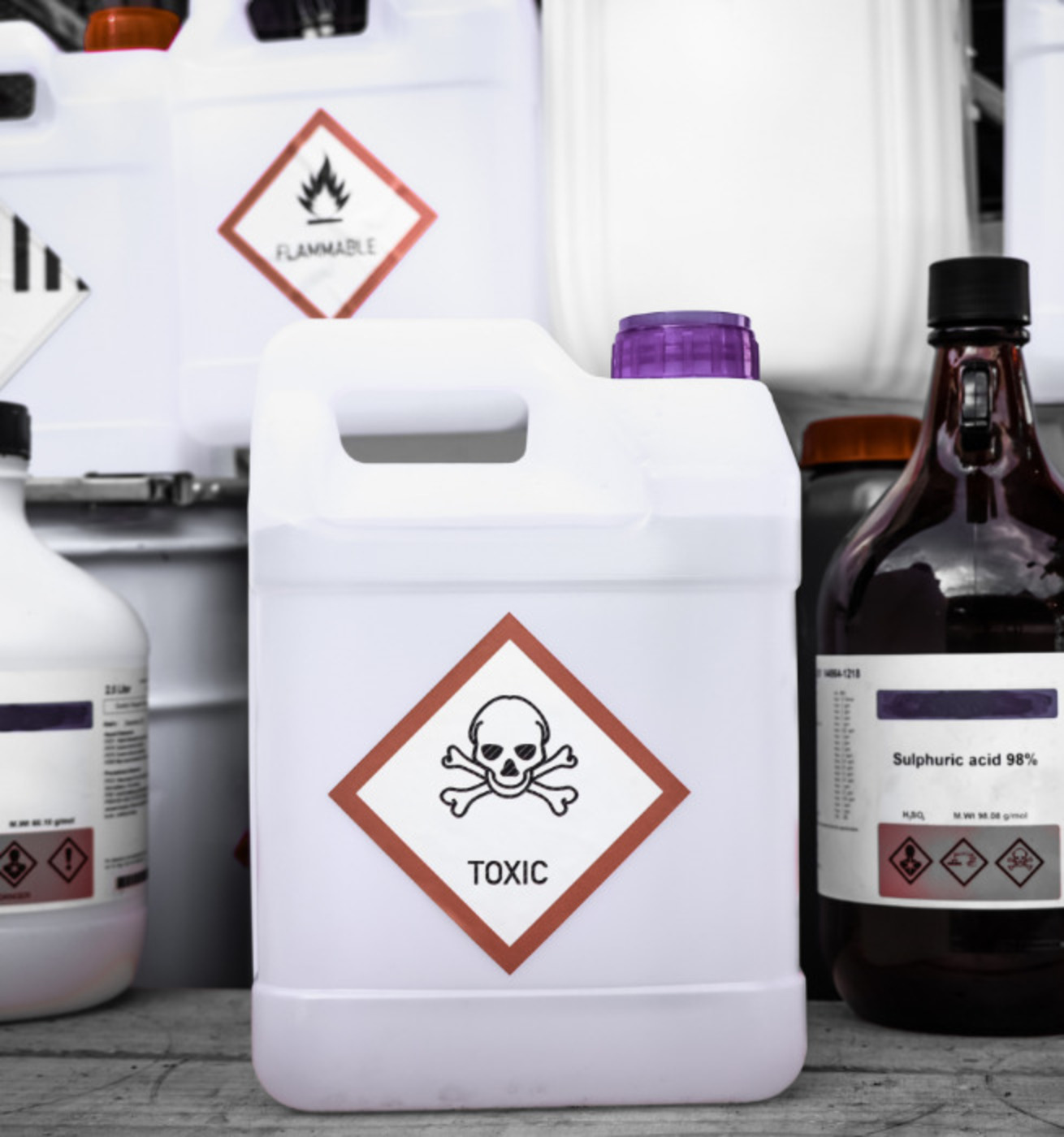
Hazardous Product Labels
WHMIS legislation requires that products used in the workplace that meet the criteria of “hazardous products” must be labelled. In most cases, suppliers are responsible for labelling the hazardous products that they provide to customers. [N.S. Reg. 52/2013, s. 3.6] Supplier labels must be available in English and French. They may be bilingual (as one label) or available as two labels (one each in English and French).
Employers must ensure that hazardous products in the workplace are labelled. They must also prepare and apply a workplace label, when appropriate.
The employer is required to update supplier labels when they become aware of new information regarding the hazard presented by a product. [N.S. Reg. 52/2013, s. 3.6(4)] This change may be:
- In the classification category or subcategory, and/or
- In the ways to protect against the hazard.
For bulk shipments and very small containers (3 mL or less), there are specific labelling requirements that apply.
- Bulk shipments: A supplier labelling exemption exists for products sold without packaging. Workplaces must affix a label to the container or use a workplace label. [N.S. Reg. 52/2013, s. 3.6(8)]
- 3 mL or less: Where the label would interfere with normal product use, the product must have a label that is durable and legible for transport and storage but may be removed during use. [N.S. Reg. 52/2013, s. 3.6(6)]
Sample Supplier Label

Workplace Labels
A workplace label is required when:
- A hazardous product is produced (made) in the workplace and used in that workplace [N.S. Reg. 52/2013, s. 3.7]
- A hazardous product is decanted into another container [N.S. Reg. 52/2013, s. 3.8]
- A supplier label becomes lost or illegible (unreadable) [N.S. Reg. 52/2013, s. 3.6(5)]
There are two situations when a workplace label is not necessary for products decanted into another container. [N.S. Reg. 52/2013, s. 3.8(2)]
- When a hazardous product is decanted into a container and will be used immediately, or
- When a hazardous product remains under the control of the person who decanted it. For example, when the person who poured the product into another container will be the only person who uses it, and the product will be used during one shift. In this case, a full workplace label may not be required. However, the contents of the container must still be clearly identified.
If the product is not used right away, or if more than one person will be in control of the product, a full workplace label is required.
In Nova Scotia, a WHMIS workplace label requires the following information: [N.S. Reg. 52/2013, s. 3.1]
- Product identifier
- Precautionary statements
- A reference to the SDS (if available)
Other Labels
Situations where alternative labels may be used include:
- Laboratory samples [N.S. Reg. 52/2013, s. 3.11]
- Under WHMIS, laboratory samples are exempt from requiring a full supplier label as long as the following is present:
- The chemical name or generic chemical name, if known.
- The statement “Hazardous Laboratory Sample. For hazard information or in an emergency, call / Échantillon pour laboratoire de produit dangereux. Pour obtenir des renseignements sur les dangers ou en cas d’urgence, composez”, and
- an emergency telephone number.
Sample Laboratory Label for WHMIS

- Hazardous products in piping systems and vessels [N.S. Reg. 52/2013, s. 3.9]
- Employers must ensure the safe use, storage and handling of hazardous products. Employee training must include the use of colour coding, labels, placards or another form of identification when the hazardous product in a workplace is contained or transferred in any of the following:
- Pipes
- Piping systems
- Process vessels
- Reaction vessels
- A tank car, tank truck, ore car, conveyor belt or similar conveyance.
- Employees must be educated and trained to be able to identify these alternate systems if they are used in the workplace.
- Hazardous products which meet at least one of the following requirements: [N.S. Reg. 52/2013, s. 3.10]
- not in a container;
- in a container intended for export;
- in a container intended for sale appropriately labelled in the employer’s normal course of business and without undue delay;
- in a container intended for use in the workplace and the container is consumed in a production process.
- These hazardous products may be labelled by posting in the area a placard that contains the information required on a workplace label. The placard must be conspicuous and clearly legible, and placed close enough to the hazardous product it relates to so that it is clear it relates to that product.
- The hazardous product must also be located in an area to which the general public and unauthorized employees are not permitted access, and the container of the hazardous product is identified through the use of colour coding, labels or another mode of identification clearly legible to employees.
Safety Data Sheets (SDSs)
Safety data sheets (SDSs) are documents that provide information about a product's hazards and safety precautions. [N.S. Reg. 52/2013, s. 3.12] SDSs are usually written by the product manufacturer or supplier. In some circumstances, an employer may be required to prepare an SDS (for example, when the product is produced and used exclusively in that workplace). [N.S. Reg. 52/2013, s. 3.13] Every product that is classified as a “hazardous product” under WHMIS that is intended for use, handling or storage in a workplace in Canada must have an SDS.
Every SDS must provide a date of last revision in Section 16 – Other Information. SDSs are required to be accurate at the time of sale. An SDS will be required to be updated when the supplier becomes aware of any significant new data. Specifically, an SDS must be updated when there is new information that changes how the hazardous product is classified, or when there are changes to the way you will handle or store or protect yourself from the product's hazards. Note that there is no requirement for the supplier to provide an updated SDS to past purchasers of a hazardous product.
Where a hazardous product used in a workplace is 3 years old or older, an employer must try to obtain an up-to-date SDS from the supplier. [N.S. Reg. 52/2013, s. 3.12(2) and (3)] If the supplier advises that the new SDS no longer applies to the original product, or there has been no change to the information on the original SDS, then this requirement does not apply.
The employer must keep records of their efforts to update SDS information.
If an employer is unable to obtain a new SDS, the employer must add any significant new data about the hazardous product that the employer is aware of to the existing. [N.S. Reg. 52/2013, s. 3.12]
Education and Training
Employees must be educated and trained so they understand the hazards and know how to work safely with hazardous products. Education and training can be thought of as two separate parts.
- Education refers to general information about how WHMIS works. For example, employees will learn about the WHMIS hazard classes and the types of information that are required on a label or SDS.
- Training is how an employer tells employees and supervisors how to safely store, handle, use, cleanup, dispose of, and respond to emergencies for a specific product in the workplace.
The employer must establish a program of employee education and training for the workplace that: [N.S. Reg. 52/2013, s. 3.5]
- Is developed and implemented in consultation with the Joint Occupational Health and Safety Committee (JOHSC) or Health and Safety representative, if any, for the place of employment
- Relates to any other hazard prevention and control program in place
- Results in employees being able to apply the information to protect their health and safety
- Periodically evaluates employee knowledge of WHMIS using written tests, practical demonstrations or other appropriate means
- Is reviewed at least once a year, in consultation with the JOHSC or Health and Safety representative, if any, to determine if any change in work conditions or available hazard information requires a change in the program of employee education, instruction and training
Employers and employees must ensure that they can answer these questions for every hazardous product they work with:
- What are the product's hazards?
- How do I protect myself from those hazards?
- What do I do in an emergency?
- Where can I get more information?
- How can I locate a SDS at the workplace and in what format can it be found?
Standard for employee WHMIS education training and evaluation
An education and training program is considered effective when employees can apply the information they were taught to protect their own health and safety and the health and safety of others at the workplace. [N.S. Reg. 52/2013, s. 3.5(4)(a)]
To determine if this standard has been met, an employer could offer practical or written tests or assess employees through other means such as job observation. [N.S. Reg. 52/2013, s. 3.5(4)(b)] For example, an employee can expect to undergo a written test as part of the generic WHMIS education evaluation, while job observations and demonstrations are often part of a site-specific training evaluation.
Many private consultants provide training services to help employers develop or present generic WHMIS employee education. Employers can also prepare and deliver their own courses, as long as all the necessary information is covered. SkillsOnlineNS also offers a free WHMIS education course available to all Nova Scotians.
Worksite-specific training includes training on the procedures (operations and emergency) established by the employer or organization, specifically related to the hazardous product(s), process or task being used or carried out. While training can be provided by an outside company, to be effective, the consultant would need to be familiar with the processes and all the hazardous products used at that workplace. The OHS Division has developed a WHMIS Training Guide to help employers to provide effective WHMIS training to their employees.
Confidential Business Information
An employer can apply to have the ingredients of a hazardous product, and the concentration of each ingredient, considered "confidential business information" (CBI). [N.S. Reg. 52/2013, s. 3.15] For example, a CBI claim may be granted if stating the ingredient name on the SDS would give competitors financial gain and/or there was a significant cost to the product development.
Under the Nova Scotia WHMIS system, there are two options for claiming a CBI exemption.
(1) Claim an exemption under the Hazardous Materials Information Review Act. [N.S. Reg. 52/2013, s. 3.17]
Each claim is given a Registry Number. The Registry Number and approval or filing date must be shown on the SDS. If the name of an ingredient is claimed as CBI, a generic chemical identity must be listed, as well as all physical or health hazard information, preventive measures and first aid.
While the ingredients may not be disclosed on the SDS, the supplier is required to disclose the ingredient's name to a safety or health professional for example, in an emergency.
Employers who produce hazardous products for their workplace and/or for commercial sales and applications have the same legal rights as suppliers to protect information that believe may affect their business. The process to follow is similar to those required by suppliers. Where required, employers must also disclose the CBI to a medical practitioner (doctor) or nurse.
(2) Claim an exemption under Section 61(1) of the Occupational Health and Safety Act. [N.S. Reg. 52/2013, s. 3.16]
The employer may delete from a label or SDS the information that is the subject of the claim but may not delete hazard information. An employer who has deleted information from a label or SDS must replace the deleted information with the words “trade secret” and provide an emergency telephone number for the employer that will enable a treating health professional to obtain information that is in the possession of the employer respecting the specific chemical identity of the hazardous product for the purpose of rendering medical treatment to a person in an emergency.
Chemicals used in the workplace that are not labelled with WHMIS elements
Consumer product labelling and Workplace Hazardous Materials Information System (WHMIS) labelling serve different purposes and target different audiences, although both aim to provide important safety information regarding chemicals.
Consumer chemical products used in the workplace present unique challenges because they may not be labelled with the same level of detail as workplace-specific chemicals under WHMIS or similar workplace regulations. However, when consumer products are used in a workplace setting, they must still be handled according to workplace safety standards to ensure the safety of employees. Most importantly, employees need to be trained in the proper safe handling, storage, use, and disposal of these products.
CCOHS has more information on consumer chemical products used in workplaces.
Legislation
Workplace Health and Safety Regulations
N.S. Reg. 52/2013
Part 1 INTERPRETATION AND APPLICATION
Section 1.4 Duties of parties
1.4 (1) A duty imposed by these regulations on an employer is also imposed on any contractor, constructor, supplier, employee, owner or self-employed person, to the extent of the contractor's, constructor's, supplier's, employee's, owner's or self-employed person's authority and ability to discharge the duty in the circumstances.
(2) For the purpose of applying Section 23 of the Act and determining the person with the greatest degree of control,
(a) the person with the greatest authority and ability to ensure that a duty is discharged or a requirement is met is presumed to be the person with the greatest degree of control over the matter that is the subject of the duty or the requirement; and
(b) a provision in a lease or other agreement relating to property rights that gives a specified owner authority to control an aspect of lands or premises that are used as a workplace is prima facie evidence that the specified owner has the greatest degree of control over that aspect of the land or premises.
Part 3 WORKPLACE HAZARDOUS MATERIALS INFORMATION SYSTEMS
Section 3.1 Definitions for Part 3
3.1 In this Part,
"bulk shipment" means a shipment of a hazardous product that is contained without intermediate containment or intermediate packaging in any of the following:
(i) a vessel that has a water capacity equal to or greater than 450 L,
(ii) a freight container, road vehicle, railway vehicle or portable tank,
(iii) the hold of a ship,
(iv) a pipeline;
"CAS registry number" means the identification number assigned to a chemical by the Chemical Abstracts Service, a division of the American Chemical Society;
"container" includes a bag, barrel, bottle, box, can, cylinder, drum, storage tank or similar package or receptacle;
"education" means the delivery of general information on labels and safety data sheets and the purpose and significance of the information they contain to employees;
"fugitive emission" means a gas, liquid, solid, vapour, fume, mist, fog or dust that escapes from any of the following and an employee may be readily exposed;
(i) process equipment,
(ii) emission control equipment,
(iii) a product;
"hazard information" means information on the proper and safe use, storage and handling of a hazardous product and includes information relating to its health and physical hazards;
"Hazardous Materials Information Review Act" means the Hazardous Materials Information Review Act (Canada);
"hazardous product" means any product, mixture, material or substance that is classified in accordance with the Hazardous Products Regulations in a category or subcategory of a hazard class listed in Schedule 2 of that Act;
"Hazardous Products Act" means the Hazardous Products Act (Canada);
"Hazardous Products Regulations" means the Hazardous Products Act ;
"hazardous waste" means a hazardous product that meets at least 1 of the following requirements:
(i) it is generated as a by-product of a process and then recycled or recovered,
(ii) it is acquired for recycling or recovery,
(iii) it is intended for disposal;
"health professional" means
(i) a physician who is registered and entitled under the laws of a province to practise medicine and who is practising medicine under those laws in that province, or
(ii) a nurse who is registered or licensed under the laws of a province to practise nursing and who is practising nursing under those laws in that province;
"label" means a group of written, printed or graphic information elements that relate to a hazardous product and that is designed to be affixed to, printed on or attached to a hazardous product or the container for a hazardous product;
"laboratory sample" means a sample of a hazardous product that is packaged in a container that contains less than 10 kg of the hazardous product and that is intended solely to be tested in a laboratory, but does not include a sample that is to be used for any of the following purposes:
(i) by the laboratory for testing other products, mixtures, materials or substances,
(ii) education,
(iii) a demonstration;
"manufactured article" means any article that is formed to a specific shape or design during manufacture, the intended use of which is dependent in whole or in part on its shape or design, and that, when being installed, if the intended use of the article requires it to be installed, and under normal conditions of use, will not release or otherwise cause an individual to be exposed to a hazardous product;
"product identifier" means, for a hazardous product, the brand, chemical, common, generic or trade name;
"readily available" means, in respect of information, present in an appropriate place that is accessible to an employee at all times and in at least 1 of the following forms:
(i) a physical copy that can be handled,
(ii) an electronic copy for which a back-up version is available;
"safety data sheet" means a document that contains, under the headings that are required to appear in the document by the Hazardous Products Regulations , information about a hazardous product, including the hazards associated with any use, handling or storage of the product in a workplace;
"significant new data" means new data about the hazard presented by a hazardous product that does any of the following:
(i) changes the hazardous product’s classification in a category or subcategory of a hazard class,
(ii) results in the hazardous product’s classification in another hazard class,
(iii) changes the ways to protect against the hazard presented by the hazardous product;
"supplier label" means a label provided by a supplier that contains the information required by the Hazardous Products Act ;
"supplier safety data sheet" means a safety data sheet provided by a supplier that contains the information required by the Hazardous Products Act ;
"training" means the delivery of workplace- and job-specific information to an employee;
"workplace label" means a label that discloses all of the following:
(i) a product identifier identical to that found on the safety data sheet for the hazardous product,
(ii) information for the safe handling of the hazardous product conveyed in a manner appropriate to the workplace,
(iii) that a safety data sheet, if supplied or produced, is available.
[N.S. Reg. 119/2024, Sch. A]
Section 3.3 Prohibition
3.3 (1) An employer must ensure that the label, identifier, safety data sheet and employee training requirements of these regulations are complied with when using, storing or handling a hazardous product in a workplace.
(2) Despite the requirement to provide information and training required for a hazardous product in a workplace under subsection (1), an employer may store a hazardous product in a workplace while actively seeking information required under these regulations if the employer ensures that the hazardous product or the container of the hazardous product has 1 of the following labels affixed to it:
(a) a workplace label; or
(b) if the employer does not have the information required for a workplace label, a label disclosing that the product is
(i) hazardous, and
(ii) cannot be used or handled at the workplace until further information is obtained.
[N.S. Reg. 119/2024, Sch. A]
Section 3.4 Employer’s duty to inform employees
3.4 (1) An employer must ensure that an employee who works with a hazardous product or may be exposed to a hazardous product in the course of their work activities is informed about all of the following:
(a) all hazard information received from a supplier for that hazardous product;
(b) any further hazard information the employer is aware of or ought to be aware of for the use, storage, handling and disposal of that hazardous product.
(2) If a hazardous product is produced in a workplace, an employer must ensure that an employee who works with that hazardous product or may be exposed to that hazardous product in the course of their work activities is informed about all of the hazard information the employer is aware of or ought to be aware of for the use, storage and handling of that hazardous product.
[N.S. Reg. 119/2024, Sch. A]
Section 3.5 Employee education and training
3.5 (1) An employer must ensure that an employee who works with, or may be exposed to, a hazardous product in the course of their work activities is educated in all of the following:
(a) the content required on a supplier label and workplace label, and the purpose and significance of that information;
(b) the content required on a safety data sheet and the purpose and significance of the information on the safety data sheet.
(2) An employer must ensure that an employee who works with, or may be exposed to, a hazardous product in the course of their work activities is trained in all of the following:
(a) procedures for the safe use, storage, handling and disposal of a hazardous product;
(b) procedures for the safe use, storage, handling and disposal of a hazardous product contained or transferred in any of the following:
(i) a pipe,
(ii) a piping system including valves,
(iii) a process vessel,
(iv) a reaction vessel,
(v) a tank car, tank truck, ore car, conveyor belt or similar conveyance;
(c) procedures to be followed if an employee may be exposed to fugitive emissions;
(d) procedures to be followed in case of an emergency involving a hazardous product;
(e) how to locate a safety data sheet at the workplace and the format it may be found in.
(3) An employer must ensure that the employee education and training required by subsections (1) and (2) are developed and implemented
(a) for that employer’s workplace; and
(b) in consultation with the committee, or representative, if any.
(4) An employer must ensure, so far as is reasonably practicable, that
(a) the employee education and training required by subsections (1) and (2) enable an employee to protect the employee’s own health and safety and the health and safety of others at the workplace; and
(b) the knowledge of an employee is periodically evaluated using written tests, practical demonstrations or other suitable means.
(5) An employer must review the education and training required under this Section at least annually, or more frequently if required by a change in work conditions or available hazard information, and in consultation with the committee or representative, if any, to ensure the education and training continue to comply with relevant legislation and regulations.
(6) If a change is made to the education or training as a result of the review under subsection (5), an employee affected by the change must be provided with additional education or training about the change.
[N.S. Reg. 119/2024, Sch. A]
Section 3.6 Supplier label
3.6 (1) Unless exempted from labelling requirements in the Hazardous Products Regulations and these regulations, an employer must ensure that all of the following received at a workplace has a supplier label that meets the requirements set out in subsection (2):
(a) a hazardous product;
(b) the container in which a hazardous product is packaged.
(2) A supplier label must be affixed to, printed on or attached to the hazardous product or the container in which the hazardous product is packaged in a manner that complies with the Hazardous Products Regulations .
(3) Except as provided in Sections 3.16 and 3.17, if any amount of a hazardous product remains in a workplace in the container in which it was received from the supplier, an employer must not remove, deface, modify or alter a supplier label.
(4) An employer must update a supplier label as soon as significant new data is provided to the employer from the supplier.
(5) Except as provided in subsection (6), if a label affixed to a hazardous product or a container of a hazardous product becomes illegible or is inadvertently removed from the hazardous product or container, the employer must replace the label with either a supplier label or a workplace label.
(6) The label of a hazardous product in a container that has a capacity of 3 ml or less may be removed under normal conditions of use if the label interferes with the normal use of the product.
(7) If a hazardous product is imported and received at a workplace without a supplier label, as permitted under Section 5.15 of the Hazardous Products Regulations , or with a supplier label that does not comply with the Hazardous Products Regulations, the employer must affix a label that meets the requirements of the Hazardous Products Regulations.
(8) An employer who receives a hazardous product without packaging or a hazardous product transported as a bulk shipment, and to which a supplier label has not been affixed as permitted under subsection 5.5(2) of the Hazardous Products Regulations , must do 1 of the following:
(a) affix a label with the information required for a supplier label to the container of the hazardous product, or
(b) if the product is to be used solely in the workplace, affix a workplace label to the hazardous product.
[N.S. Reg. 119/2024, Sch. A]
Section 3.7 Workplace label for employer-produced products
3.7 (1) For the purpose of subsection (2), "produces" does not include the production of a fugitive emission.
(2) If an employer produces a hazardous product in a workplace, the employer must ensure that the hazardous product or the container of the hazardous product has a workplace label affixed to it.
(3) Subsection (2) does not apply when the hazardous product is in a container that is intended to contain the hazardous product for sale or disposition and the container is or is about to be appropriately labelled for sale or disposition.
(4) The employer must update a workplace label as soon as significant new data are available to the employer.
[N.S. Reg. 119/2024, Sch. A]
Section 3.8 Workplace label for decanted products
3.8 (1) Except as set out in subsection (2), if a hazardous product in a workplace is in a container other than the container in which it was received from a supplier, the employer must ensure that the container has a workplace label affixed to it.
(2) Subsection (1) does not apply to a portable container that is filled directly from a container that has a supplier label or workplace label affixed to it if either of the following conditions are met:
(a) all of the hazardous product is required for immediate use; or
(b) the hazardous product meets all of the following requirements:
(i) it is under the control of and is used exclusively by the employee who filled the portable container,
(ii) it is used only during the shift in which the portable container was filled,
(iii) the content of the container holding the hazardous product is clearly identified.
[N.S. Reg. 119/2024, Sch. A]
Section 3.9 Identification of hazardous product in piping systems and vessels
3.9 An employer must ensure the safe use, storage and handling of a hazardous product through employee training and the use of colour coding, labels, placards or another mode of identification when the hazardous product in a workplace is contained or transferred in any of the following:
(a) a pipe;
(b) a piping system including valves;
(c) a process vessel;
(d) a reaction vessel;
(e) a tank car, tank truck, ore car, conveyor belt or similar conveyance.
[N.S. Reg. 119/2024, Sch. A]
Section 3.10 Placard identifiers
3.10 (1) For the purpose of this Section, "posting a placard" means posting a placard that meets all of the following requirements:
(a) except as exempted in Sections 3.16 and 3.17, it discloses the information required on a workplace label;
(b) it is of a size and in a location that the information on the placard is conspicuous and clearly legible to employees;
(c) it is located close enough to the hazardous product it relates to for employees to appreciate it relates to that product.
(2) Despite the labelling requirements for a hazardous product in Sections 3.6, 3.7 and 3.8, an employer may comply with Sections 3.6, 3.7 and 3.8 by posting a placard if the hazardous product meets at least 1 of the following requirements:
(a) it is not in a container;
(b) it is in a container intended for export;
(c) it is in a container intended for sale or disposition and will be appropriately labelled in the employer’s normal course of business and without undue delay;
(d) it is in a container intended for use in the workplace and the container meets all of the following requirements:
(i) the container is consumed in a production process,
(ii) except as exempted in Sections 3.16 and 3.17, the container or the hazardous product is identified through the use of colour coding, labels or another mode of identification clearly legible to employees.
(3) Despite the labelling requirements for a hazardous product in Sections 3.7 and 3.8, and without limiting subsection (2), an employer may comply with Sections 3.7 and 3.8 for a container of a hazardous product intended for use in a workplace by posting a placard if all of the following requirements are met:
(a) the hazardous product is located in an area to which the general public and unauthorized employees are not permitted access;
(b) the container of the hazardous product is identified through the use of colour coding, labels or another mode of identification clearly legible to employees;
(c) subject to subsection (4), and unless the hazardous product is required for immediate use or is under the exclusive control of a single employee and handled in accordance with subclauses 3.8(2)(b)(i) to (iii), the hazardous product is not removed from the placarded area until it has a workplace label affixed to it.
(4) If a hazardous product is moved directly and expeditiously from a container or source that complies with the labelling or placarding requirements of these regulations to an area where a placard is posted, despite Sections 3.7 and 3.8, the employer may, during the time that the hazardous product is being moved, identify the hazardous product through a combination of employee training and the use of colour coding, labels, placards or another mode of identification clearly legible to employees.
[N.S. Reg. 119/2024, Sch. A]
Section 3.11 Hazardous laboratory sample
3.11 (1) If a laboratory sample of a hazardous product is exempted from specific labelling requirements by subsection 5(5) or 5(6) of the Hazardous Products Regulations , a label must be provided by the supplier and affixed to, printed on or attached to the container of the product received at the workplace.
(2) A label in subsection (1) complies with the requirements of Section 3.6 for a supplier label if it discloses all of the following:
(a) the chemical name or generic chemical name of any material or substance in the hazardous product that is classified individually under the Hazardous Products Act and the Hazardous Products Regulations
(i) in any category or subcategory of a health hazard class and that is present above the relevant concentration limit, if known by the supplier, or
(ii) that is present at a concentration that results in the mixture being classified in a category or subcategory of any health hazard class, if known by the supplier;
(b) the statement "Hazardous Laboratory Sample. For hazard information or in an emergency, call/Échantillon pour laboratoire de produit dangereux. Pour obtenir des renseignements sur les dangers ou en cas d’urgence, composez" followed by an emergency telephone number to obtain the information required on the safety data sheet of the hazardous product.
(3) If a hazardous product is in a container other than the container in which it was received from a supplier, or is produced in the workplace, the employer is exempt from the requirement of Section 3.8 if the hazardous product meets all of the following requirements:
(a) it is a laboratory sample;
(b) it is intended by the employer solely for use, analysis, testing or evaluation in a laboratory;
(c) it is clearly identified through a combination of the following methods that comply with subsection (4):
(i) a mode of identification visible to employees at the workplace,
(ii) employee education and training required by these regulations.
(4) The mode of identification and employee education and training required under clause (3)(c) must enable an employee to readily identify and obtain either of the following types of information as required in the circumstances:
(a) information required on a safety data sheet;
(b) a label or document disclosing the information referred to in clauses (2)(a) and (b) for the hazardous product or sample.
(5) If a hazardous product is produced in a laboratory, the employer is exempt from the labelling requirements of Sections 3.7 and 3.8 if the hazardous product meets all of the following requirements:
(a) it is intended by the employer solely for evaluation, analysis or testing for research and development;
(b) it is not removed from the laboratory;
(c) it is clearly identified through a combination of the following methods that comply with subsection (6):
(i) a mode of identification visible to employees at the workplace,
(ii) employee education and training required by these regulations.
(6) The mode of identification and employee education and training methods required under clause (5)(c) must enable an employee to readily identify and obtain at least 1 of the following:
(a) information required on a safety data sheet;
(b) any other information that is necessary to ensure the safe use, storage and handling of the hazardous product.
[N.S. Reg. 119/2024, Sch. A]
Section 3.12 Supplier safety data sheets
3.12 (1) Except as provided in subsection (6), an employer who acquires a hazardous product for use, handling or storage at a workplace must obtain a supplier safety data sheet that complies with the requirements of the Hazardous Products Regulations for that hazardous product.
(2) Except as provided in subsection (3), if a safety data sheet for a hazardous product that is used in the workplace is 3 or more years old, the employer must, if possible, obtain from the supplier an up-to-date supplier safety data sheet for the hazardous product in the workplace.
(3) Subsection (2) does not apply if the supplier advises the employer that
(a) the new safety data sheet does not apply to the original product; or
(b) there has been no change to the information on the original safety data sheet.
(4) If an employer is unable to obtain a safety data sheet as required by subsection (2), the employer must add any significant new data applicable to that hazardous product that the employer is aware of, or ought to be aware of, to the existing supplier safety data sheet.
(5) An employer may provide a safety data sheet in a different format than the format provided by the supplier or that contains additional hazard information if the safety data sheet provided by the employer meets all of the following requirements:
(a) except as provided in Sections 3.16 and 3.17, it does not contain less information than the supplier safety data sheet or it contains less information and this is accepted by the committee, or representative, if any;
(b) the supplier safety data sheet is available at the workplace and the safety data sheet provided by the employer indicates that fact.
(6) If a supplier is exempted by the Hazardous Products Regulations from the requirement to provide a safety data sheet for a hazardous product, an employer is exempt from the requirement to obtain or provide a safety data sheet for that hazardous product.
(7) Except as provided in Sections 3.16 and 3.17, if a hazardous product is received at a laboratory and the supplier has provided a safety data sheet, an employer must ensure that a copy of the safety data sheet is readily available for viewing by an employee who may be exposed to the hazardous product and by the committee, or representative, if any.
(8) Except as provided in Sections 3.16 and 3.17, if a hazardous product is received or produced at a laboratory and an employer has produced a safety data sheet, the employer must ensure that the safety data sheet is readily available for viewing by an employee who may be exposed to the hazardous product, and by the committee, or representative, if any.
[N.S. Reg. 119/2024, Sch. A]
Section 3.13 Employer safety data sheets
3.13 (1) If an employer produces a hazardous product in the workplace, the employer must prepare a safety data sheet for the product that discloses the information required under the Hazardous Products Regulations , except as provided in Sections 3.16 and 3.17 and Part 5 of the Hazardous Products Regulations.
(2) Subsection (1) does not apply to the production of a fugitive emission or an intermediate product undergoing reaction within a reaction or process vessel.
(3) An employer must update the safety data sheet referred to in subsection (1) as soon as practical but no later than 90 days after the date that new hazard information becomes available to the employer.
[N.S. Reg. 119/2024, Sch. A]
Section 3.14 Availability of safety data sheets
3.14 (1) An employer must consult the committee, or representative, if any, respecting the most appropriate means to make a safety data sheet required by Section 3.12 or 3.13 readily available in the workplace.
(2) An employer must ensure that a copy of the safety data sheet is made readily available to an employee who may be exposed to a hazardous product and the committee, or representative, if any.
[N.S. Reg. 119/2024, Sch. A]
Section 3.15 Claim of exemption to disclose information
3.15 (1) An employer who is required, either directly or indirectly, under the provisions of the Hazardous Products Act , the Hazardous Products Regulations or these regulations, to disclose any of the information set out in subsection (2) on a label or safety data sheet may claim an exemption if the employer considers it to be confidential business information.
(2) The information for which an exemption may be claimed under subsection (1) includes all of the following:
(a) for a material or substance that is a hazardous product
(i) the chemical name of the material or substance,
(ii) the CAS registry number, or any other unique identifier, of the material or substance, and
(iii) the chemical name of any impurity, stabilizing solvent or stabilizing additive that is present in the material or substance, that is classified in a category or subcategory of a health hazard class under the Hazardous Products Act and that contributes to the classification of the material or substance in the health hazard class under that Act;
(b) for an ingredient contained in a mixture that is a hazardous product
(i) the chemical name of the ingredient,
(ii) the CAS registry number, or any other unique identifier, of the ingredient, and
(iii) the concentration or concentration range of the ingredient;
(c) for a material, substance or mixture that is a hazardous product, the name of any toxicological study that identifies the material or substance or an ingredient in the mixture;
(d) the product identifier of a hazardous product, such as its chemical, common, generic, trade or brand name;
(e) information about a hazardous product, other than the product identifier, that constitutes a means of identification;
(f) information that could be used to identify a supplier of a hazardous product.
(3) A claim under subsection (1) may be made under
(a) subsection 61(1) of the Act; or
(b) the Hazardous Materials Information Review Act .
[N.S. Reg. 119/2024, Sch. A]
Section 3.16 Claims for exemption under subsection 61(1) of Act
3.16 (1) If an employer claims an exemption from a requirement to disclose confidential information under subsection 61(1) of the Act, the employer may delete from a label or safety data sheet the information that is the subject of the claim but may not delete hazard information.
(2) An employer who has deleted information from a label or safety data sheet under subsection (1) must replace the deleted information with
(a) the words "trade secret"; and
(b) an emergency telephone number for the employer that will enable a treating health professional to obtain information that is in the possession of the employer respecting the specific chemical identity of the hazardous product for the purpose of rendering medical 30 treatment to a person in an emergency.
[N.S. Reg. 119/2024, Sch. A]
Section 3.17 Claims for exemption under Hazardous Materials Information Review Act
3.17 (1) If an employer claims an exemption from a requirement to disclose confidential business information under the Hazardous Materials Information Review Act , the information is exempt from disclosure from the time a claim is filed until the final disposition of the claim and, if the claim is found to be valid, for a period of 3 years from the date that the claim is determined.
(2) An employer who claims an exemption under the Hazardous Materials Information Review Act may delete, for the time period set out in subsection (1), the information claimed to be confidential business information from a label or safety data sheet required under Sections 3.6, 3.12 and 3.13, but may not delete hazard information from the label or safety data sheet.
(3) An employer who claims an exemption under the Hazardous Materials Information Review Act must abide by the process and any decisions issued under the Hazardous Materials Information Review Act and its regulations.
(4) An employer who claims an exemption from a requirement to disclose information about a hazardous product on a safety data sheet or label under the Hazardous Materials Information Review Act must disclose on the safety data sheet and, if applicable, on the label of the hazardous product or container in which the hazardous product is packaged, the date that the claim for exemption was filed and the registry number assigned to the claim under the Hazardous Materials Information Review Act.
(5) The requirements under subsection (4) apply until at least 1 of the following conditions is met:
(a) in the case of an order issued under subsection 14(1) of the Hazardous Materials Information Review Act , the end of the period that begins on the final disposition of the claim for exemption and does not exceed the period specified in the order;
(b) in any other case, the end of the period not exceeding 30 days after the final disposition of the claim for exemption.
(6) An employer who receives notice of a decision made under the Hazardous Materials Information Review Act that their claim or a portion of their claim for exemption from a requirement to disclose information about a hazardous product on a safety data sheet or label is valid must, for the sale or importation of the hazardous product, provide all of the following information on the safety data sheet and, if applicable, on the label of the hazardous product or container in which the hazardous product is packaged:
(a) a statement that an exemption has been granted;
(b) the date of the decision granting the exemption;
(c) the registry number assigned to the claim under the Hazardous Materials Information Review Act.
(7) If an employer produces a hazardous product in the workplace and files a claim for exemption under paragraph 11(2)(a) or subparagraph 11(2)(b)(i) or (ii) of the Hazardous Materials Information Review Act, the employer is compliant with subsection 3.13(1) if the employer prepares a safety data sheet for that hazardous product that discloses at least 1 of the following in place of the information elements listed in paragraphs 3(1)(a), (b), (c) and (d) or paragraphs 3(2)(a), (b) and (c) of Schedule 1 to the Hazardous Products Regulations :
(a) for a hazardous product that is a material or substance, the generic chemical name of the material or substance;
(b) for a hazardous product that is a mixture, the generic chemical name of each material or substance in the mixture
(i) that, individually, is classified in a category or subcategory of a health hazard class under the Hazardous Products Act and is present above the relevant concentration limit, or
(ii) that is present at a concentration that results in the mixture being classified in a category or subcategory of a health hazard class under the Hazardous Products Act.
(8) If an employer produces a hazardous product in the workplace and files a claim for exemption under subparagraph 11(2)(b)(iii) of the Hazardous Materials Information Review Act , the employer is compliant with subsection 3.13(1) if the employer prepares a safety data sheet for that hazardous product that does not disclose the information element listed in paragraph 3(2)(d) of Schedule 1 to the Hazardous Products Regulations .
(9) If an employer produces a hazardous product in the workplace and files a claim for exemption under paragraph 11(2)(d) of the Hazardous Materials Information Review Act , the employer is compliant with subsection 3.13(1) if the employer prepares a safety data sheet for that hazardous product that discloses, in place of the product identifier, a code name or code number for the product.
[N.S. Reg. 119/2024, Sch. A]