



Did you know?
Exposure to a low level of carbon monoxide over a long period (weeks or months) can cause flu-like symptoms, including headaches, fatigue, nausea, and vomiting. Exposure to a high concentration of carbon monoxide can cause death within minutes.
Summary
Carbon monoxide (CO) is a colourless, odourless, and tasteless gas. Exposure to carbon monoxide is hazardous and can be fatal. When inhaled, it reduces the blood's ability to carry oxygen throughout the body. It can affect vital organs before you even realize that you have been exposed.
Carbon monoxide is produced whenever fuels are burned. There are many sources of carbon monoxide in workplaces throughout Nova Scotia. It is also flammable.
Common Sources of Carbon Monoxide
Appliances, vehicles, and equipment that burn any type of fuel can become a health risk when they are used indoors or in poorly ventilated areas. Common sources of carbon monoxide include:
- vehicle exhaust
- forklifts and other mobile equipment
- furnaces
- water heaters
- boilers
- gas or propane clothing dryers
- gas, propane, or charcoal barbecues
- cooking appliances
- generators
- portable space heaters
- pressure washers
Signs and Symptoms of Carbon Monoxide Exposure
| Health effects of carbon monoxide | |
| Low concentration | High concentration |
| Tiredness | Seizures |
| Dizziness/confusion | Loss of consciousness |
| Headaches | Coma |
| Chest pain | Death |
The brain and heart are the organs most affected by oxygen deprivation. Carbon monoxide exposure can injure the heart and aggravate pre-existing cardiovascular diseases, such as coronary artery disease.
Exposure to a low level of carbon monoxide over a long period (weeks or months) can cause flu-like symptoms, including headaches, fatigue, nausea, and vomiting.
Moderate to severe carbon monoxide poisoning can cause long-term or permanent neurological effects, such as poor concentration, memory problems, personality changes, depression, anxiety, impaired vision, and effects that mimic Parkinson's Disease.
Exposure to a high concentration of carbon monoxide can cause death within minutes. At a concentration of 1200 parts per million (ppm) carbon monoxide is immediately dangerous to life and health (IDLH).
What should you do if you suspect carbon monoxide is in a building?
- Leave the area immediately and move outdoors to fresh air
- Once outside, call 911
- If it is safe to do so:
- turn off the fuel source
- remove sources of ignition to prevent fire
- Do not re-enter the building until the problem has been fixed by a professional
How to manage risk of carbon monoxide exposure
The best way to control risk is to eliminate the hazard. If it is not possible to eliminate the hazard, then another risk control option should be used. Personal protective equipment (PPE) should be used as a last resort, and only in combination with other control measures.
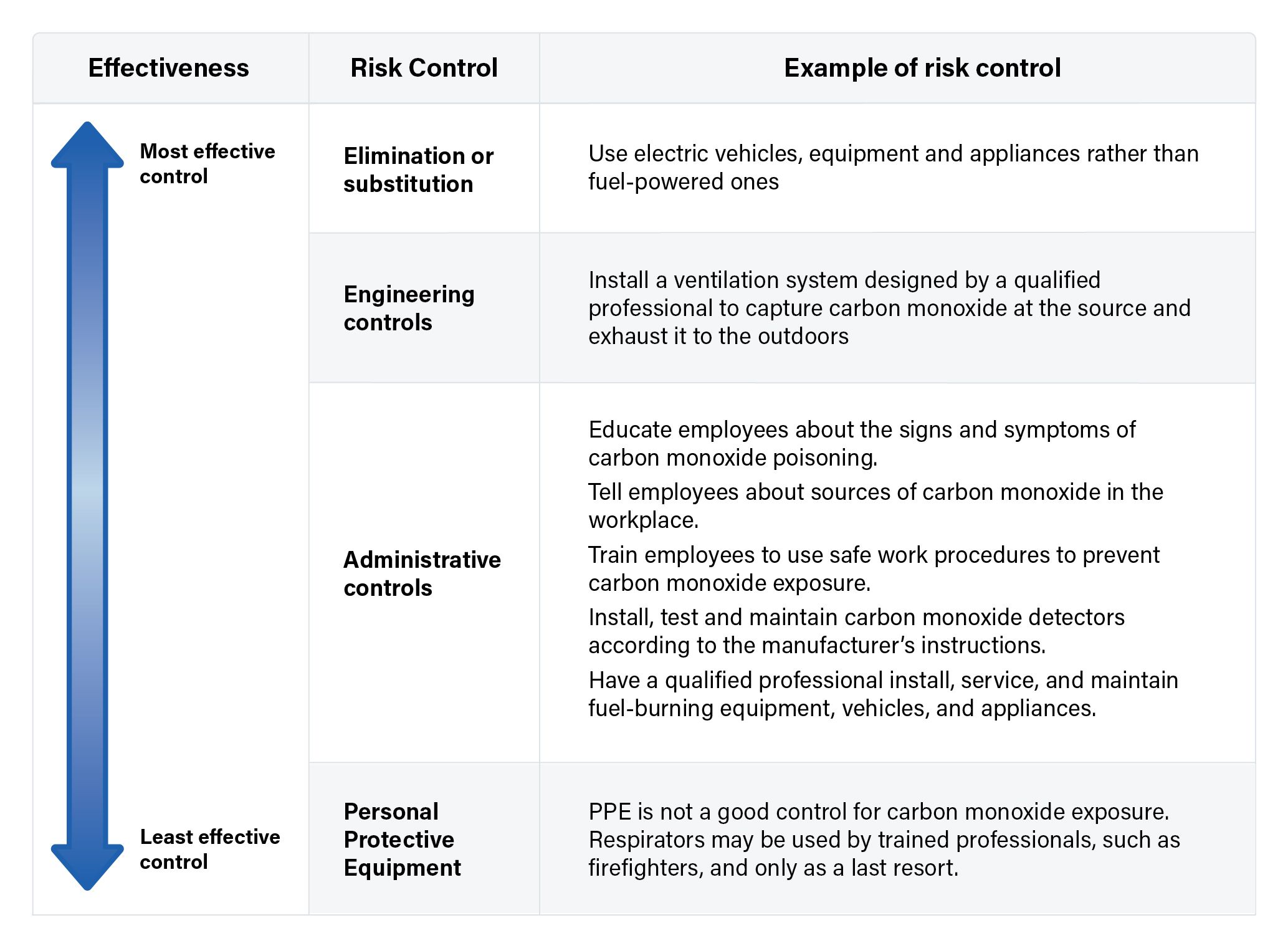
Carbon monoxide is colourless and odourless, so the use of personal protective equipment, such as respirators, has significant limitations. Air-purifying respirators require a canister specifically approved for carbon monoxide and must only be used under appropriate, monitored conditions.
Legal information
General
The Nova Scotia Fire Safety Regulations require carbon monoxide detectors to be inspected, tested, and maintained according to the manufacturer’s instructions.
The National Building Code of Canada specifies where a carbon monoxide alarm is required, and the standard that the alarm must conform to.
- A carbon monoxide alarm is required in a building designated for “residential occupancy” or “care occupancy” if the building has a fuel-burning appliance or storage garage.
- A Building Official in Nova Scotia can answer questions about occupancy classification and the need for a carbon monoxide alarm.
- Older buildings do not need to be retrofitted when an updated version of the Code is adopted in regulation unless a Building Official or Fire Inspector requires the installation of additional fire safety equipment due to unsafe conditions.
- For information about how to monitor carbon monoxide and the use of a carbon monoxide detector, please see the Carbon Monoxide Safety Guideline.
The Nova Scotia Fuel Safety Regulations apply to certain workplaces:
- Fuel-burning equipment and appliances must be installed, maintained, and serviced by qualified, trained, and licensed installers.
- Installers are required to ensure that fuel appliances are operating correctly and safely upon installation or servicing.
- Building owners should be familiar with their fuel burning systems and know when to call for service.
- Building owners must ensure that air intakes and exhaust vents are not blocked by high snow levels, or other obstructions.
- Building owners should install carbon monoxide monitors in all buildings with fuel burning equipment.
Nova Scotia’s Occupational Health and Safety Act and its regulations (Workplace Health and Safety Regulations; Occupational Safety General Regulations) set the following requirements:
An employer must:
- Take all reasonable precautions to protect workers and others at or near the workplace from exposure to carbon monoxide [S.N.S. 1996, c.7, s. 13(1)(a)]
- Make sure there is enough fresh air coming into the workplace and that the air is clean. [N.S. Reg. 44/99, s. 15(a)]
- Provide and maintain equipment, machines, materials or things that are properly equipped with safety devices and ensure that the employees are made familiar with the proper use of all devices, equipment and clothing required for their protection. [S.N.S. 1996, c.7, s. 13(1)(b)] [S.N.S. 1996, c.7, s. 13(1)(e)]
- Provide information, training, supervision, and facilities that are needed to ensure that the employees, supervisors, and foremen are familiar with the health or safety hazards that may be present at the workplace. This duty applies to carbon monoxide. [S.N.S. 1996, c.7, s. 13(1)(c)] [S.N.S. 1996, c.7, s. 13(1)(d)]
- Conduct the required undertakings to protect workers from health and safety hazards, and occupational diseases, including carbon monoxide poisoning. If any worker develops an occupational disease and it is recognized by the Board as being related to their work, the worker may then be eligible for compensation. [S.N.S. 1996, c.7, s. 13(1)(f)] [R.S.N.S. 1994-95, c. 10, s. 12(3)] [N.S. Reg. 22/96 , S.19]
- Consult and cooperate with the Joint Occupational Health and Safety Committee, or the Health and Safety Representative [S.N.S. 1996, c.7, s.13(2)(a)]
- Co-operate with any person performing a duty imposed or exercising a power under the legislation. [S.N.S. 1996, c.7, s.13(2)(b)]
- Establish the required Occupational Health and Safety Policy or Occupational Health and Safety Program. This duty applies to carbon monoxide. [S.N.S. 1996, c.7, s.13(2)(e)]
An employee must:
- While at work, take every reasonable precaution in the circumstances to protect their own health and safety and the health and safety of other persons at or near the workplace. [S.N.S. 1996, c.7, s. 17(1)(a)]
- Use protective devices and equipment required by their employer or required by law. [S.N.S. 1996, c. 7, s. 17(1)(c)]
- Report to a supervisor any condition, device, equipment, machine, material, thing or any aspect of the workplace that is or may be dangerous to their health or safety or that of any other person at the workplace. [S.N.S. 1996, c.7, s. 17(2)]
- Notify the employer of any damaged personal protective equipment. [S.N.S. 1996, c. 7, s. 17]
- Use or wear all required personal protective equipment, including respiratory protection, according to the instructions and training. [N.S. Reg. 44/99, s. 9A]
- Not operate diesel-powered equipment in an underground mine if the carbon monoxide level in the undiluted exhaust gas is 1200 ppm or higher while the engine is idling. [N.S. Reg. 296/2008, s. 271(1)(b)]
Threshold Limit Values
An employer must:
- Make sure that workers are not exposed to airborne concentrations of carbon monoxide gas that exceed the threshold limit value (TLV®), which is an 8-hour time-weighted average of 25 parts per million (ppm). [N.S. Reg. 52/2013, s. 2.1] [N.S. Reg. 52/2013, s. 2.3]
- Threshold Limit Values (TLVs®) represent the airborne concentrations of chemical substances and conditions under which it is believed that nearly all healthy workers may be repeatedly exposed, day after day, over a working lifetime, without adverse effects.[N.S. Reg. 52/2013, s. 2.1]
- Threshold Limit Values (TLV®s) should not be viewed as a fine line between safe and unsafe worker exposures. Since carbon monoxide exposure can cause carbon monoxide poisoning, which can be life-threatening or fatal, employers should keep worker exposures as low as possible.
- For information about how to monitor carbon monoxide and the use of a carbon monoxide detector, please see the Carbon Monoxide Safety Guideline.
Ventilation
An employer must:
- Make sure fresh air is supplied into, and air is removed from, a workplace so far as reasonably practicable to keep the air reasonably pure and safe to breathe. [N.S. Reg. 44/99, s. 15(a)]
- When there is a process that generates carbon monoxide that is likely to be inhaled by workers and cause them harm, use mechanical means (e.g., ventilation) to:
- prevent such inhalation so far as reasonably practicable
- effectively carry off and dispose of the carbon monoxide gas, and
- prevent the recirculation or re-entry of the carbon monoxide gas into the workplace. [N.S. Reg. 44/99, s. 15(b)]
- Make sure that all ventilation systems used for controlling exposure to carbon monoxide gases are designed, installed, operated, maintained and repaired in an adequate manner by a competent person. [N.S. Reg. 44/99, s. 15(c)]
Lift Trucks
An employer must:
- Where a lift truck with an internal combustion engine operates inside a building or other enclosed area, make sure there is adequate ventilation, air monitoring, and record keeping to ensure worker exposure to exhaust gases, including carbon monoxide, remain below the applicable Threshold Limit Values (TLVs®). [N.S. Reg. 44/99, s. 82(1A)]
Personal Protective Equipment
An employer must:
- Provide adequate personal protective equipment (PPE) based on the nature of the task, the location and conditions of the workplace, and any hazards that may affect the health and safety of others in the workplace. [N.S. Reg. 44/99, s. 9(1)]
- Make sure that workers are trained in the proper use and care of the personal protective equipment or devices. [N.S. Reg. 44/99, s. 9(2)]
- Make sure that adequate personal protective equipment is used when needed, and that it is maintained and tested according to the manufacturer’s instructions. [N.S. Reg. 44/99, s. 9(3)]
Respiratory Protection
An employer must:
- Provide and make sure the use of an adequate respirator appropriate for the hazard when a worker is exposed to a respiratory hazard that may cause harm. [N.S. Reg. 44/99, s. 13(1)]
- Make sure that compressed breathing air used in a respirator complies with or exceeds the latest version of CSA Standard CAN3 Z180.1, “Compressed Breathing Air Systems.” [N.S. Reg. 44/99, s. 13(2)]
- Comply with the latest version of CSA Standard CSA Z94.4, “Selection, Use, and Care of Respirators,” regarding the selection, use, maintenance and testing of a respirator, and training of workers who use a respirator. [N.S. Reg. 44/99, s. 13(3)]
- Provide each person who enters an underground mine with a self-rescuer that provides protection against dust and has a capacity of at least 60 minutes at 1% by volume of carbon monoxide in the air. [N.S. Reg. 296/2008, s. 88(2)]
- If a person may travel underground to a point that is more than a 30-minute walk from the surface or a refuge station, the provided self-rescuer must protect them from air containing 1% carbon monoxide for at least twice the time needed to walk from the farthest point they may travel underground to the nearest refuge station or the surface, whichever is closer. [N.S. Reg. 296/2008, s. 88(4)(a)]
Legislation
Occupational Health and Safety Act
S.N.S. 1996, c. 7
Section 13 DUTIES AND PRECAUTIONS
- 13. (1) Every employer shall take every precaution that is reasonable in the circumstances to
- (a) ensure the health and safety of persons at or near the workplace;
- (b) provide and maintain equipment, machines, materials or things that are properly equipped with safety devices;
- (c) provide such information, instruction, training, supervision and facilities as are necessary to the health or safety of the employees;
- (d) ensure that the employees, and particularly the supervisors and foremen, are made familiar with any health or safety hazards that may be met by them at the workplace;
- (e) ensure that the employees are made familiar with the proper use of all devices, equipment and clothing required for their protection; and
- (f) conduct the employer's undertaking so that employees are not exposed to health or safety hazards as a result of the undertaking.
- (2) Every employer shall
- (a) consult and co-operate with the joint occupational health and safety committee, where such a committee has been established at the workplace, or the health and safety representative, where one has been selected at the workplace;
- (b) co-operate with any person performing a duty imposed or exercising a power conferred by this Act or the regulations;
- (c) provide such additional training of committee members or the representative as may be prescribed by the regulations;
- (d) comply with this Act and the regulations and ensure that employees at the workplace comply with this Act and the regulations; and
- (e) where an occupational health and safety policy or occupational health and safety program is required pursuant to this Act or the regulations, establish the policy or program.
- (3) The employer at a subsea coal mine shall provide such additional resources or information for the committee as may be prescribed by the regulations.
- (4) Every employer shall, in accordance with the regulations, establish and implement a policy respecting the prevention of harassment in the workplace.
[N.S. 2007, c. 14, s. 7; 2010, c. 66, s. 5; 2024, c. 10, s. 13]
Section 17
- 17. (1) Every employee, while at work, shall
- (a) take every reasonable precaution in the circumstances to protect the employee's own health and safety and that of other persons at or near the workplace;
- (b) co-operate with the employer and with the employee's fellow employees to protect the employee's own health and safety and that of other persons at or near the workplace;
- (c) take every reasonable precaution in the circumstances to ensure that protective devices, equipment or clothing required by the employer, this Act or the regulations are used or worn;
- (d) consult and co-operate with the joint occupational health and safety committee, where such a committee has been established at the workplace, or the health and safety representative, where one has been selected at the workplace;
- (e) co-operate with any person performing a duty or exercising a power conferred by this Act or the regulations; and
- (f) comply with this Act and the regulations.
- (2) Where an employee believes that any condition, device, equipment, machine, material or thing or any aspect of the workplace is or may be dangerous to the employee's health or safety or that of any other person at the workplace, the employee shall
- (a) immediately report it to a supervisor;
- (b) where the matter is not remedied to the employee's satisfaction, report it to the committee or the representative, if any; and
- (c) where the matter is not remedied to the employee's satisfaction after the employee reports in accordance with clauses (a) and (b), report it to the Division.
Workplace Health and Safety Regulations
N.S. Reg. 52/2013
Part 2 OCCUPATIONAL HEALTH
Section 2.1 Definitions for Part 2
2.1 In this Part,
- "physical agent", in relation to threshold limit values for occupational exposure, means an agent of acoustic, electromagnetic, ergonomic, mechanical or thermal nature;
- "threshold limit values" means the threshold limit values established by the TLVs and BEIs that represent
- (i) for chemical substances, the airborne concentrations of chemical substances and conditions under which it is believed that nearly all healthy workers may be repeatedly exposed, day after day, over a working lifetime, without adverse health effects,
- (ii) for physical agents, the levels of exposure and conditions under which it is believed that nearly all healthy workers may be repeatedly exposed, day after day, without adverse health effects,
- "TLVs and BEIs" means the latest version of the publication of the American Conference of Governmental Industrial Hygienists of threshold limit values and biological exposure indices.
Section 2.3 Threshold limit values
2.3 An employer must comply with, and ensure compliance with, the threshold limit values for exposure to all of the following, as listed in the TLVs and BEIs:
- (a) gases;
- (b) vapours;
- (c) mists;
- (d) fumes;
- (e) smoke;
- (f) dust;
- (g) chemical substances;
- (h) physical agents.
Workers' Compensation General Regulations
N.S. Reg. 22/96
Section 19 Occupational diseases
19. The processes, trades or occupations, and the corresponding occupational diseases listed in Appendix "B" are listed for the purposes of subsection 12(3) of the Act.
Occupational Safety General Regulations
N.S. Reg. 44/99
Part 1 Title and Definitions
Section 2 Definitions
2. In these regulations,
- (a) "Act" means the Occupational Health and Safety Act ;
- (aa) "adequate" means sufficient to protect a person from injury or damage to health;
- (b) "ALI" means the Automotive Lift Institute;
- (ba) "angle of repose" means the angle with the horizontal at which material will no longer flow freely;
- (c) "ANSI" means the American National Standards Institute;
- (ca) "approved" means approved by the Department or by an agency or authority designated or selected by the Department to make approvals;
- (d) "ASME" means the American Society of Mechanical Engineers;
- (e) "ASTM" means the American Society for Testing and Materials;
- (ea) "CGA" means the Compressed Gas Association;
- (f) "CGSB" means the Canadian General Standards Board;
- (g) "competent person" means a person who is
- (i) qualified because of their knowledge, training and experience to do the assigned work in a manner that ensures the health and safety of every person in the workplace, and
- (ii) knowledgeable about the provisions of the Act and regulations that apply to the assigned work, and about potential or actual danger to health or safety associated with the assigned work;
- (ga) "compressed air" means air mechanically raised to a pressure higher than atmospheric pressure;
- (h) "CSA" means the Canadian Standards Association;
- (i) "demolition" means the destruction or removal of all, or part, of an existing building or structure;
- (ia) "Department" means the Department of Labour and Advanced Education;
- (j) "designated" means, in relation to an employer, appointed in writing by the employer;
- (k) "electrical installation" means the wires, machinery, apparatus, appliances, devices, material and equipment used or intended for use for the generation, transmission, distribution, supply and use of electrical power or energy, and includes a power line and power line equipment;
- (l) "engineer" means a person who is registered as a member or licensed to practise under the Engineering Profession Act and is competent to do the work being performed;
- (m) "firefighter" means
- (i) an employee who provides fire suppression services to the public from a fire department within a municipality or local service district, or
- (ii) an industrial firefighter;
- (n) "guardrail" means a fall protection system consisting of vertical and horizontal members that
- (i) are capable of withstanding concentrated forces, as prescribed in these regulations or an applicable standard,
- (ii) warn of a fall hazard, and
- (iii) reduce the risk of a fall;
- (o) "hazardous substance" means chemical or biological material, dangerous goods within the meaning of the Dangerous Goods Transportation Act or a controlled product within the meaning of the Hazardous Products Act (Canada) that is likely to, because of its harmful nature, cause injury or damage to the health or safety of a person exposed to it;
- (p) "hoist" means a device or equipment and its structure used for lifting or lowering material, including cranes, an automotive lift, a winch, a chain fall or other similar device, but does not include a lift truck, a power operated elevating work platform, a device to which the Elevators and Lifts Act applies or a hoist that operates in a shaft in the underground at a mine;
- (pa) "ITSDF" means the Industrial Truck Standards Development Foundation;
- (q) "industrial firefighter" means an employee who
- (i) is designated to fight fires at the employee's place of employment, and
- (ii) is employed by an employer who does not, in the normal course of its business, provide fire suppression services to the public;
- (qa) "latest version" means, in relation to a standard or other publication, the latest edition of the standard or publication as supplemented, amended, added to, replaced or superseded;
- (r) "lift truck" means a lift truck as defined in the latest version of ANSI standard ANSI/ITSDF B56.1, "Safety Standard for Low Lift and High Lift Trucks";
- (s) "locked out" means to have
- (i) isolated the energy source or sources from a machine, equipment, tool or electrical installation,
- (ii) dissipated any residual energy in a system, and
- (iii) secured the isolation of the energy source or sources by an inhibiting device that is operated by a key or other process,
- and to have performed a "lock-out" has a similar meaning;
- (t) "machine" Repealed. [N.S. Reg. 52/2000, s. 1]
- (u) "manufacturer's specifications" means
- (i) the written instructions of a manufacturer of a machine, material, tool or equipment that outline the manner in which the machine, material, tool or equipment is to be erected, installed, assembled, started, operated, used, handled, stored, stopped, adjusted, carried, maintained, repaired, inspected, serviced, tested, cleaned or dismantled, and
- (ii) a manufacturer's instruction, operating or maintenance manual and drawings respecting a machine, tool or equipment;
- (ua) "mobile crane" means a mobile crane to which the latest version of CSA standard CSA Z150 , "Safety Code on Mobile Cranes" applies;
- (v) "NFPA" means the National Fire Protection Association;
- (va) "overhead crane" means any mechanical device or structure that is used to raise, lower and move material that travels overhead and that incorporates a
- (i) power driven drum, bridge and cable or rope,
- (ii) single or multiple girder, and
- (iii) moveable bridge carrying a moveable or fixed hoisting mechanism,
- but does not include wall cranes, cantilever gantry cranes and semi-gantry cranes;
- (vb) "personal flotation device" means personal protective equipment that is capable of supporting a person with their head above water without the direct effort of the person wearing the equipment;
- (w) "power line" means the above-ground or underground wiring that is used to distribute electricity;
- (x) "power line equipment" means the components that are required to distribute electricity by means of a power line;
- (y) "power operated elevating work platform" means a mobile horizontal working surface that provides access and support to a person at a workplace, and that is elevated and lowered by means of a mechanism and [that complies with] Part 23: Scaffolds and Other Elevated Work Platforms, of the Workplace Health and Safety Regulations made under the Act, including a standard listed in subsection (4) thereof;
- (z) "powered mobile equipment" means self-propelled equipment that is designed to operate on land in conditions other than a public highway, but does not include equipment primarily designed to transport persons, a lift truck or a power operated elevating work platform;
- (aa) "SAE" means the Society of Automotive Engineers;
- (ab) "structural fire-fighting" means the activities of rescue, fire suppression and conservation of property from fires involving buildings, structures, vehicles, vessels, aircraft or other large objects constructed by human effort;
- (ac) "surface mine" means a work or undertaking, other than a trench, for the purpose of opening up, proving, removing or extracting any metallic or non-metallic mineral or mineral bearing substance, rock, earth, clay, sand or gravel by means of an open excavation, and includes a pit or quarry;
- (ad) "tower crane" means any mechanical device or structure that
- (i) incorporates a power-driven drum and cable or rope and a vertical mast or tower and a jib,
- (ii) is of the traveling, fixed or climbing type, and
- (iii) is used exclusively for raising, lowering and moving material;
- (ae)"trench" means an excavation in which the excavation depth exceeds the excavation width;
- (af) "work area" means a location at the workplace at which an employee or self-employed person is or is likely to be working;
- (ag) "worked" means drilled, blasted, extracted, excavated, loaded or subjected to other similar work.
[N.S. Reg. 52/2000, s. 1; 151/2003; 53/2013, ss. 1, 93]
Part 3 Personal Protective Equipment
Section 9A
9A An employee shall wear or use personal protective equipment or devices as required under clause 9(2)(b).
[N.S. Reg. 52/2000, s. 4]
Section 9 Use of personal protective equipment
- 9. (1) An employer shall ensure that adequate personal protective equipment or devices required for an assigned task are used, based on
- (a) the nature of the task;
- (b) the location and conditions of the workplace; and
- (c) any hazards that may affect the health and safety of persons in the workplace.
- (2) Where personal protective equipment or devices are required under the Act or these regulations, an employer shall ensure that
- (a) an employee receives adequate training in the proper use and care of the personal protective equipment or devices; and
- (b) an employee wears or uses the personal protective equipment or devices in accordance with the instruction and training provided.
- (3) An employer shall ensure that all personal protective equipment or devices required under the Act or these regulations are
- (a) maintained by a competent person; and
- (b) tested or visually inspected before each use,
- in accordance with the manufacturer's specifications.
- (4) Where a person identifies any defect in personal protective equipment or devices that may impair the adequacy of the equipment or devices, the employer shall ensure that the personal protective equipment or devices are not used until they are repaired.
[N.S. Reg. 52/2000, s. 3; 53/2013, s. 93]
Section 13 Respiratory hazard
- 13. (1) Where a person is exposed to a respiratory hazard that may cause injury or disease, an employer shall provide and ensure the use of an adequate respirator that is appropriate to the hazard.
- (2) An employer shall ensure that the compressed breathing air used in a respirator complies with or exceeds the latest version of CSA standard Z180.1 , "Compressed Breathing Air and Systems".
- (3) An employer shall ensure compliance with the latest version of CSA standard CSA Z94.4 , "Selection, Use, and Care of Respirators", in respect of
- (a) the selection, use, maintenance and testing of a respirator; and
- (b) the training of users of a respirator.
- (4) Repealed. [N.S. Reg. 53/2013, s. 11]
[N.S. Reg. 52/2000, s. 7; 53/2013, s. 11]
Part 4 Ventilation, Lighting, Sanitation and Accommodation
Section 15 Ventilation
15. An employer shall
- (a) provide for a supply of fresh air into, and the removal of air from, a workplace or part thereof that is, so far as is reasonably practicable, sufficient to
- (i) keep the air reasonably pure, and
- (ii) render harmless all gases, vapours, dust or other impurities that are likely to endanger the health or safety of any person therein;
- (b) where a process is carried on that produces a gas, vapour, dust or other impurity that is likely to be inhaled to an injurious extent by a person in the workplace, provide and use such mechanical means as are capable of
- (i) preventing such inhalation so far as is reasonably practicable,
- (ii) effectively carrying off and disposing of the impurity, and
- (iii) preventing the recirculation and re-entry into the workplace of air containing the impurity; and
- (c) ensure that all ventilation systems used for controlling the dissemination of gases, vapours, dust or other impurities, including their collection systems and emptying processes, are designed, installed, operated, maintained and repaired in an adequate manner by a competent person.
[N.S. Reg. 52/2000, s. 8]
Part 7 Hoists and Mobile Equipment
Section 82
- 82. (1) An employer must ensure that a lift truck is operated in a manner that will not endanger a person.
- (1A) Where a lift truck is propelled by an internal combustion engine in a building or other enclosed structure, the employer must ensure adequate ventilation, monitoring and record keeping practices are carried out to ensure exposure from exhaust gases does not exceed the occupational exposure limit for the gas under Part 2: Occupational Health, of the Workplace Health and Safety Regulations made under the Act.
- (2) An employer shall ensure that where a lift truck is operated
- (a) in a one-way aisle, the width of the aisle equals at least the width of the vehicle or load being carried, whichever is wider, plus 600 mm; and
- (b) in a two-way aisle, the width of the aisle equals at least twice the width of the vehicle or load being carried, whichever is wider, plus 900 mm.
- (3) An employer must ensure that a lift truck that is propelled by propane has all engine and fuel components designed, assembled, examined, inspected, operated and maintained in accordance with the latest version of CSA standard CSA B149.2 , "Propane Storage and Handling Code".
[N.S. Reg. 53/2013, ss. 36, 93]
83. Repealed. [N.S. Reg. 53/2013, s. 37]
Underground Mining Regulations
N.S. Reg. 296/2008
Part 3 GENERAL SAFETY REQUIREMENTS AND WORK PROCEDURES
Section 88 Self-rescuers
- 88. (1) An employer must provide each person who enters the underground with all of the following:
- (a) an adequately maintained self-rescuer that meets the requirements of subsection (2) or (4);
- (b) training in the use of a self-rescuer in accordance with the manufacturer's specifications.
- (2) A self-rescuer must meet all of the following minimum criteria:
- (a) it provides protection against dust;
- (b) it has a capacity of at least 60 minutes at 1% by volume of carbon monoxide in the air.
- (3) A person must carry an adequate self-rescuer at all times while underground.
- (4) If a person might travel underground to a point that is farther from the surface or a refuge station than the distance an average person would walk in 30 minutes, 1 of the following must be met:
- (a) the self-rescuer provided under subsection (1) must be capable of protecting the user at 1% by volume of carbon monoxide in the air for at least twice the time it would take the average person to walk to the surface or a refuge station, whichever is closer, from the farthest point the person might travel to;
- (b) if the person has access to a self-contained breathing apparatus at the person's workplace, the self-contained breathing apparatus must be capable of protecting the user for twice the time it would take the average person to walk to the surface or a refuge station, whichever is closer, from the farthest point the person might travel to;
- (c) caches of self-rescuers must be placed in adequate numbers at locations as follows:
- (i) each cache must be located in an area in which precautions have been taken to minimize contamination during an emergency,
- (ii) each self-rescuer in a cache must be capable of providing protection for twice the time it would take the average person to walk to the closest of the following:
- (A) the next cache,
- (B) the surface,
- (C) a refuge station, and
- (iii) each cache must be identified with adequate signage.
Part 9 MECHANICAL EQUIPMENT AND TRAVELWAYS
Section 271 Carbon monoxide from diesel-powered equipment exhaust
- 271. (1) A person must not operate diesel-powered equipment underground if the undiluted exhaust gases discharging from its engine while the engine is idling reach or exceed 1200 ppm by volume of carbon monoxide.
- (2) Tests must be conducted on the engine exhaust of diesel-powered equipment used underground while the engine is idling to determine the carbon monoxide concentration of the undiluted exhaust gases discharging from the engine at all of the following times: (
- a) immediately after repairs to the engine or the exhaust system of the diesel-powered equipment;
- (b) when recommended by the manufacturer or monthly, whichever is more frequent.
- (3) A record of the tests conducted under subsection (2) must be kept that includes all of the following:
- (a) the identification number of the diesel-powered equipment required by Section 265;
- (b) the date of the tests;
- (c) the results of the tests.
Workers' Compensation Act
S.N.S. 1994-95, c. 10
Part I WORKERS' COMPENSATION
Section 12 Compensation for occupational disease
- 12. (1) Where an occupational disease is due to the nature of any employment to which this Part applies in which a worker was engaged, whether under one or more employments, and
- (a) the occupational disease results in loss of earnings or permanent impairment; or
- (b) the worker's death is caused by the occupational disease,
- the worker is entitled to compensation as if the occupational disease was a personal injury by accident.
- (2) Where a worker suffers from an occupational disease, the date of the worker's injury, for the purpose of this Act, is the earliest of
- (a) the date on which the occupational disease results in loss of earnings;
- (b) the date on which the Board determines the worker has a permanent impairment caused by the occupational disease; or
- (c) the date on which the worker's death is caused by the occupational disease.
- (3) Where any worker
- (a) was employed at or immediately before the date of injury in any process, trade or occupation prescribed by the Board by regulation; and
- (b) the disease contracted by the worker is set opposite to the description of the process, trade or occupation in the regulations,
- the disease contracted by the worker is presumed, unless the contrary is shown, to have been due to the worker's employment in that process, trade or occupation.
- (4) Nothing in this Section affects the right of a worker to compensation in respect of a disease to which this Section does not apply, if the disease is the result of any injury in respect of which the worker is entitled to compensation pursuant to this Part.
- (5) Notwithstanding subsection (1), no compensation is payable to a worker who suffers from an occupational disease where, at the time of entering into employment, the worker has made a wilful and false representation that the worker did not previously suffer from the occupational disease for which the worker is claiming compensation.