


Did you know?
Over 10,000 employees in Nova Scotia are exposed to silica dust that can cause chronic lung diseases. Most of these people work in construction and skilled trades.
Summary
What is respirable crystalline silica?
Crystalline silica is a mineral naturally found in sand and rock, usually in the form of quartz. When these materials are worked on, they can create dust that contains silica that a worker may inhale. Tiny dust particles that can reach the lungs are called 'respirable' particles - hence the term "respirable crystalline silica".
What building materials contain silica?
- Concrete
- Engineered stone
- Cement
- Natural stone
- Brick
- Drywall
- Mortar
- Asphalt
- Sand, soil, dirt
- Tile
Who is at risk of exposure?
Exposure can happen whenever dust is created from materials that contain silica. Poor dust control can put others in the workplace at risk too.
The largest groups of at-risk workers in Nova Scotia are in construction and the skilled trades. Many building materials contain silica. Routine tasks, like crushing, sawing, hammering, grinding, drilling, sanding, mixing, and sweeping all create dust that can result in silica exposure for a worker.
Exposure also occurs in industries that mine, process, and transport raw materials like sand, gravel, stone, minerals, oil and gas. Silica materials are also used in many manufacturing processes, including cement, ceramics, metals, glass, electronics, and rubber. Specific tasks in other industries, such as abrasive blasting, are also associated with silica exposure.
Health effects
When a worker inhales tiny silica dust particles, their body can’t remove the particles from the lungs. There are no immediate health effects, so it may seem harmless at first. Over time, these particles build up and cause damage. Workers who are repeatedly exposed to high levels of silica dust are at greater risk of developing permanent lung diseases, such as silicosis, chronic obstructive pulmonary disease (COPD), and lung cancer. These are debilitating conditions that can affect daily life and longevity. They don’t often develop until 10 or more years after exposure begins. However, in the case of silicosis, workers with very high exposures may develop the disease within months to a few years. Employers, supervisors and employees should strive to keep silica exposure as low as possible.
How do you know if there is a risk of silica dust exposure in the workplace?
Hazard identification and risk assessments for silica should be performed by a competent person. This would typically include the following steps:
- Identify possible sources of dust in the workplace.
- Determine if the source material contains silica.
- If the source material contains silica, conduct an exposure assessment. This may involve evaluating exposure data from similar workplaces, or engaging a qualified person, such as an occupational hygienist, to collect air samples.
- Compare the levels of worker exposure to crystalline silica with the established Threshold Limit Value (TLV) occupational exposure limit.
- If there is risk of overexposure, implement control measures to reduce exposure to a safe level (see hazard control measures below).
- Reassess to confirm control measures are effective.
The hazard and risk assessment should be documented and shared with employees. It should be updated at regular intervals, when new information becomes available, and when there have been changes that could impact exposure. Re-evaluating exposures after control measures have been implemented should also be done to ensure the measures in place are protecting workers.
Hazard control
When implementing control measures to protect workers from harmful exposures to silica dust, the hierarchy of controls should be considered. This method involves implementing the most effective and reliable control measures first.
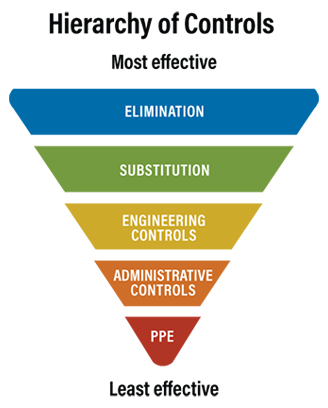
Controls need to be evaluated to determine if they will introduce new hazards. Any new hazard also needs to be assessed and controlled. Once controls are implemented, it is important to evaluate their effectiveness and adjust as required.
Examples of silica control measures
Elimination:
- Remove sources of silica dust from the workplace. For example, use silica-free materials for abrasive blasting.
Substitution:
- Use alternative products that have lower concentrations of silica.
- Replace manual work methods with automated processes.
Engineering Controls
- Use wet methods, such as water spray when cutting or grinding, to put less dust in the air.
- Isolate or enclose processes that generate silica dust or isolate the equipment operator (e.g., in a control room, vehicle cab).
- Improve or redesign cutting methods, such as automated cutting, using sharper blades, and reducing the number of cuts.
- Lower the speed of machinery to reduce airborne dust (e.g., during cutting, sanding, grinding, polishing).
- Use local exhaust ventilation to capture silica dust at the source.
- Use high-efficiency particulate air (HEPA) vacuum attachments on tools to capture dust.
Administrative Controls
- Train and educate workers on the hazards, procedures, and control measures.
- Implement a medical surveillance program and enrol workers potentially exposed to silica dust (may include chest X-rays, computed tomography (CT) scans, pulmonary lung function tests, etc.).
- Develop and enforce safe work procedures.
- Use good housekeeping, including using wet methods and HEPA vacuums to capture dust, and do not allow dry sweeping or cleaning with compressed air.
- Develop and follow equipment testing and maintenance schedules.
- Develop personal protective equipment (PPE) and respiratory protection programs (including fit testing procedures, clean-shaven policy, health screening).
- Ensure silica-containing waste is properly managed and disposed of.
- Organize work areas and schedules to separate workers from tasks that generate silica dust.
- Use job rotation to reduce the duration of exposure to silica dust.
- Perform air quality monitoring at regular intervals.
Personal Protective Equipment
- Make sure workers use the appropriate personal protective equipment, including respiratory protection.
- Develop and maintain a written respirator protection program that details how the employer will manage the risk of respiratory hazards and use the equipment.
Employer duties
An employer must:
General
- Take reasonable precautions to protect the health and safety of workers and other persons at or near the workplace. This duty applies to protecting people from harmful exposure to silica dust. [S.N.S. 1996, c.7, s. 13(1)]
- Provide the information, training, supervision, and facilities that are needed to ensure that the employees, supervisors, and foremen are familiar with the health or safety hazards that may be met by them at the workplace. This duty applies to silica dust. [S.N.S. 1996, c.7, s. 13(1)]
- Provide and maintain equipment, machines, materials or things that are properly equipped with safety devices, and ensure that the employees are made familiar with the proper use of all devices, equipment and clothing required for their protection [S.N.S. 1996, c.7, s. 13(1)]
Threshold Limit Values
- Ensure that workers are not exposed to airborne concentrations of crystalline silica that exceed the Threshold Limit Value (TLV®), which is an 8-hour time-weighted average of 0.025 mg/m3 (respirable fraction). [N.S. Reg. 52/2013, s. 2.1] [N.S. Reg. 52/2013, s. 2.3]
- Threshold Limit Values (TLVs®) represent the airborne concentrations of chemical substances and conditions under which it is believed that nearly all healthy workers may be repeatedly exposed, day after day, over a working lifetime, without adverse effects. [N.S. Reg. 52/2013, s. 2.1]
- Threshold Limit Values (TLV®s) should not be viewed as a fine line between safe and unsafe worker exposures. Since silica dust exposure can cause silicosis and cancer, employers should strive to keep worker exposures as low as possible.
Ventilation
- Make sure fresh air is supplied into, and air is removed from, a workplace so far as reasonably practicable to keep the air reasonably pure and safe to breathe. [N.S. Reg. 44/99, s. 15(a)]
- When there is a process that generates silica dust that is likely to be inhaled by workers and cause them harm, use mechanical means (e.g., ventilation) to:
- prevent such inhalation so far as reasonably practicable
- effectively carry off and dispose of the silica dust, and
- prevent the recirculation or re-entry of the silica dust into the workplace. [N.S. Reg. 44/99, s. 15(b)]
- Make sure that all ventilation systems used for controlling exposure to silica dust, including the collection systems and emptying processes, are designed, installed, operated, maintained and repaired in an adequate manner by a competent person. [N.S. Reg. 44/99, s. 15(c)]
Personal Protective Equipment – all types of PPE
- Provide adequate personal protective equipment (PPE) based on the nature of the task, the location and conditions of the workplace, and any hazards that may affect the health and safety of persons in the workplace. [N.S. Reg. 44/99, s. 9(1)]
- Ensure that employees are trained in the proper use and care of the personal protective equipment or devices. [N.S. Reg. 44/99, s. 9(2)]
- Ensure that adequate personal protective equipment is used when needed, and that it is maintained and tested according to the manufacturer’s instructions. [N.S. Reg. 44/99, s. 9(3)]
Respiratory Protection
- Provide and ensure the use of an adequate respirator appropriate for the hazard when a worker is exposed to a respiratory hazard that may cause harm. [N.S. Reg. 44/99, s. 13(1)]
- Make sure that compressed breathing air used in a respirator complies with or exceeds the latest version of CSA Standard CAN3 Z180.1, “Compressed Breathing Air Systems.” [N.S. Reg. 44/99, s. 13(2)]
- Comply with the latest version of CSA Standard CSA Z94.4, “Selection, Use, and Care of Respirators,” regarding the selection, use, maintenance and testing of a respirator, and training of workers that use a respirator. [N.S. Reg. 44/99, s. 13(3)]
Waste material and debris
- Ensure that waste material and debris are collected or positioned to prevent a hazard and removed from a workplace to a suitable disposal area. [N.S. Reg. 44/99, s. 24]. Silica dust is a waste material that can be a hazard if it accumulates in the workplace.
Workplace Hazardous Materials Information System (WHMIS)
- Be aware that some products that contain silica, such as certain abrasive materials used in sand blasting, are classified as “hazardous products”. If an employee works with, or may be exposed to, a hazardous product when they are working, then the WHMIS regulations apply.
- Provide education to employees about WHMIS, including the information that must be included on a safety data sheet and label of a hazardous product. [N.S. Reg. 52/2013, s. 3.5(1)].
- Provide training to employees on how to work safely with the hazardous products that are in their workplace. This training includes the procedures for the safe use, storage, handling and disposal of a hazardous product. [N.S. Reg. 52/2013, s. 3.5].
General Duties of an Employee
An employee must:
- While at work, take every reasonable precaution in the circumstances to protect the employee’s own health and safety and that of other persons at or near the workplace [S.N.S. 1996, c.7, s. 17(1)(a)].
- Use protective devices and equipment required by their employer or required by law. [S.N.S. 1996, c. 7, s. 17]
- Report to a supervisor any condition, device, equipment, machine, material, thing or any aspect of the workplace that is or may be dangerous to the employee’s health or safety or that of any other person at the workplace [S.N.S. 1996, c.7, s. 17(2)].
- Use or wear all required personal protective equipment, including respiratory protection, according to the instructions and training. [N.S. Reg. 44/99, s. 9A]
- Notify the employer of any damaged personal protective equipment. [S.N.S. 1996, c. 7, s. 17]
Legislation
OCCUPATIONAL HEALTH AND SAFETY ACT
S.N.S. 1996, c. 7
Section 13 DUTIES AND PRECAUTIONS
13. (1) Every employer shall take every precaution that is reasonable in the circumstances to
(a) ensure the health and safety of persons at or near the workplace;
(b) provide and maintain equipment, machines, materials or things that are properly equipped with safety devices;
(c) provide such information, instruction, training, supervision and facilities as are necessary to the health or safety of the employees;
(d) ensure that the employees, and particularly the supervisors and foremen, are made familiar with any health or safety hazards that may be met by them at the workplace;
(e) ensure that the employees are made familiar with the proper use of all devices, equipment and clothing required for their protection; and
(f) conduct the employer's undertaking so that employees are not exposed to health or safety hazards as a result of the undertaking.
(2) Every employer shall
(a) consult and co-operate with the joint occupational health and safety committee, where such a committee has been established at the workplace, or the health and safety representative, where one has been selected at the workplace;
(b) co-operate with any person performing a duty imposed or exercising a power conferred by this Act or the regulations;
(c) provide such additional training of committee members or the representative as may be prescribed by the regulations;
(d) comply with this Act and the regulations and ensure that employees at the workplace comply with this Act and the regulations; and
(e) where an occupational health and safety policy or occupational health and safety program is required pursuant to this Act or the regulations, establish the policy or program.
(3) The employer at a subsea coal mine shall provide such additional resources or information for the committee as may be prescribed by the regulations.
(4) Every employer shall, in accordance with the regulations, establish and implement a policy respecting the prevention of harassment in the workplace.
[N.S. 2007, c. 14, s. 7; 2010, c. 66, s. 5; 2024, c. 10, s. 13]
Section 17
17. (1) Every employee, while at work, shall
(a) take every reasonable precaution in the circumstances to protect the employee's own health and safety and that of other persons at or near the workplace;
(b) co-operate with the employer and with the employee's fellow employees to protect the employee's own health and safety and that of other persons at or near the workplace;
(c) take every reasonable precaution in the circumstances to ensure that protective devices, equipment or clothing required by the employer, this Act or the regulations are used or worn;
(d) consult and co-operate with the joint occupational health and safety committee, where such a committee has been established at the workplace, or the health and safety representative, where one has been selected at the workplace;
(e) co-operate with any person performing a duty or exercising a power conferred by this Act or the regulations; and
(f) comply with this Act and the regulations.
(2) Where an employee believes that any condition, device, equipment, machine, material or thing or any aspect of the workplace is or may be dangerous to the employee's health or safety or that of any other person at the workplace, the employee shall
(a) immediately report it to a supervisor;
(b) where the matter is not remedied to the employee's satisfaction, report it to the committee or the representative, if any; and
(c) where the matter is not remedied to the employee's satisfaction after the employee reports in accordance with clauses (a) and (b), report it to the Division.
Occupational Safety General Regulations
N.S. Reg. 44/99
Part 1 Title and Definitions
Section 2 Definitions
2. In these regulations,
(a) "Act" means the Occupational Health and Safety Act ;
(aa) "adequate" means sufficient to protect a person from injury or damage to health;
(b) "ALI" means the Automotive Lift Institute;
(ba) "angle of repose" means the angle with the horizontal at which material will no longer flow freely;
(c) "ANSI" means the American National Standards Institute;
(ca) "approved" means approved by the Department or by an agency or authority designated or selected by the Department to make approvals;
(d) "ASME" means the American Society of Mechanical Engineers;
(e) "ASTM" means the American Society for Testing and Materials;
(ea) "CGA" means the Compressed Gas Association;
(f) "CGSB" means the Canadian General Standards Board;
(g) "competent person" means a person who is
(i) qualified because of their knowledge, training and experience to do the assigned work in a manner that ensures the health and safety of every person in the workplace, and
(ii) knowledgeable about the provisions of the Act and regulations that apply to the assigned work, and about potential or actual danger to health or safety associated with the assigned work;
(ga) "compressed air" means air mechanically raised to a pressure higher than atmospheric pressure;
(h) "CSA" means the Canadian Standards Association;
(i) "demolition" means the destruction or removal of all, or part, of an existing building or structure;
(ia) "Department" means the Department of Labour and Advanced Education;
(j) "designated" means, in relation to an employer, appointed in writing by the employer;
(k) "electrical installation" means the wires, machinery, apparatus, appliances, devices, material and equipment used or intended for use for the generation, transmission, distribution, supply and use of electrical power or energy, and includes a power line and power line equipment;
(l) "engineer" means a person who is registered as a member or licensed to practise under the Engineering Profession Act and is competent to do the work being performed;
(m) "firefighter" means
(i) an employee who provides fire suppression services to the public from a fire department within a municipality or local service district, or
(ii) an industrial firefighter;
(n) "guardrail" means a fall protection system consisting of vertical and horizontal members that
(i) are capable of withstanding concentrated forces, as prescribed in these regulations or an applicable standard,
(ii) warn of a fall hazard, and
(iii) reduce the risk of a fall;
(o) "hazardous substance" means chemical or biological material, dangerous goods within the meaning of the Dangerous Goods Transportation Act or a controlled product within the meaning of the Hazardous Products Act (Canada) that is likely to, because of its harmful nature, cause injury or damage to the health or safety of a person exposed to it;
(p) "hoist" means a device or equipment and its structure used for lifting or lowering material, including cranes, an automotive lift, a winch, a chain fall or other similar device, but does not include a lift truck, a power operated elevating work platform, a device to which the Elevators and Lifts Act applies or a hoist that operates in a shaft in the underground at a mine;
(pa) "ITSDF" means the Industrial Truck Standards Development Foundation;
(q) "industrial firefighter" means an employee who
(i) is designated to fight fires at the employee's place of employment, and
(ii) is employed by an employer who does not, in the normal course of its business, provide fire suppression services to the public;
(qa) "latest version" means, in relation to a standard or other publication, the latest edition of the standard or publication as supplemented, amended, added to, replaced or superseded;
(r) "lift truck" means a lift truck as defined in the latest version of ANSI standard ANSI/ITSDF B56.1, "Safety Standard for Low Lift and High Lift Trucks";
(s) "locked out" means to have
(i) isolated the energy source or sources from a machine, equipment, tool or electrical installation,
(ii) dissipated any residual energy in a system, and
(iii) secured the isolation of the energy source or sources by an inhibiting device that is operated by a key or other process,
and to have performed a "lock-out" has a similar meaning;
(t) "machine" Repealed. [N.S. Reg. 52/2000, s. 1]
(u) "manufacturer's specifications" means
(i) the written instructions of a manufacturer of a machine, material, tool or equipment that outline the manner in which the machine, material, tool or equipment is to be erected, installed, assembled, started, operated, used, handled, stored, stopped, adjusted, carried, maintained, repaired, inspected, serviced, tested, cleaned or dismantled, and
(ii) a manufacturer's instruction, operating or maintenance manual and drawings respecting a machine, tool or equipment;
(ua) "mobile crane" means a mobile crane to which the latest version of CSA standard CSA Z150 , "Safety Code on Mobile Cranes" applies;
(v) "NFPA" means the National Fire Protection Association;
(va) "overhead crane" means any mechanical device or structure that is used to raise, lower and move material that travels overhead and that incorporates a
(i) power driven drum, bridge and cable or rope,
(ii) single or multiple girder, and
(iii) moveable bridge carrying a moveable or fixed hoisting mechanism,
but does not include wall cranes, cantilever gantry cranes and semi-gantry cranes;
(vb) "personal flotation device" means personal protective equipment that is capable of supporting a person with their head above water without the direct effort of the person wearing the equipment;
(w) "power line" means the above-ground or underground wiring that is used to distribute electricity;
(x) "power line equipment" means the components that are required to distribute electricity by means of a power line;
(y) "power operated elevating work platform" means a mobile horizontal working surface that provides access and support to a person at a workplace, and that is elevated and lowered by means of a mechanism and [that complies with] Part 23: Scaffolds and Other Elevated Work Platforms, of the Workplace Health and Safety Regulations made under the Act, including a standard listed in subsection (4) thereof;
(z) "powered mobile equipment" means self-propelled equipment that is designed to operate on land in conditions other than a public highway, but does not include equipment primarily designed to transport persons, a lift truck or a power operated elevating work platform;
(aa) "SAE" means the Society of Automotive Engineers;
(ab) "structural fire-fighting" means the activities of rescue, fire suppression and conservation of property from fires involving buildings, structures, vehicles, vessels, aircraft or other large objects constructed by human effort;
(ac) "surface mine" means a work or undertaking, other than a trench, for the purpose of opening up, proving, removing or extracting any metallic or non-metallic mineral or mineral bearing substance, rock, earth, clay, sand or gravel by means of an open excavation, and includes a pit or quarry;
(ad) "tower crane" means any mechanical device or structure that
(i) incorporates a power-driven drum and cable or rope and a vertical mast or tower and a jib,
(ii) is of the traveling, fixed or climbing type, and
(iii) is used exclusively for raising, lowering and moving material;
(ae)"trench" means an excavation in which the excavation depth exceeds the excavation width;
(af) "work area" means a location at the workplace at which an employee or self-employed person is or is likely to be working;
(ag) "worked" means drilled, blasted, extracted, excavated, loaded or subjected to other similar work.
[N.S. Reg. 52/2000, s. 1; 151/2003; 53/2013, ss. 1, 93]
Part 3 Personal Protective Equipment
Section 9 Use of personal protective equipment
9. (1) An employer shall ensure that adequate personal protective equipment or devices required for an assigned task are used, based on
(a) the nature of the task;
(b) the location and conditions of the workplace; and
(c) any hazards that may affect the health and safety of persons in the workplace.
(2) Where personal protective equipment or devices are required under the Act or these regulations, an employer shall ensure that
(a) an employee receives adequate training in the proper use and care of the personal protective equipment or devices; and
(b) an employee wears or uses the personal protective equipment or devices in accordance with the instruction and training provided.
(3) An employer shall ensure that all personal protective equipment or devices required under the Act or these regulations are
(a) maintained by a competent person; and
(b) tested or visually inspected before each use,
in accordance with the manufacturer's specifications.
(4) Where a person identifies any defect in personal protective equipment or devices that may impair the adequacy of the equipment or devices, the employer shall ensure that the personal protective equipment or devices are not used until they are repaired.
[N.S. Reg. 52/2000, s. 3; 53/2013, s. 93]
Section 9A
9A An employee shall wear or use personal protective equipment or devices as required under clause 9(2)(b).
[N.S. Reg. 52/2000, s. 4]
Section 13 Respiratory hazard
13. (1) Where a person is exposed to a respiratory hazard that may cause injury or disease, an employer shall provide and ensure the use of an adequate respirator that is appropriate to the hazard.
(2) An employer shall ensure that the compressed breathing air used in a respirator complies with or exceeds the latest version of CSA standard Z180.1 , "Compressed Breathing Air and Systems".
(3) An employer shall ensure compliance with the latest version of CSA standard CSA Z94.4 , "Selection, Use, and Care of Respirators", in respect of
(a) the selection, use, maintenance and testing of a respirator; and
(b) the training of users of a respirator.
(4) Repealed. [N.S. Reg. 53/2013, s. 11]
[N.S. Reg. 52/2000, s. 7; 53/2013, s. 11]
Part 4 Ventilation, Lighting, Sanitation and Accommodation
Section 15 Ventilation
15. An employer shall
(a) provide for a supply of fresh air into, and the removal of air from, a workplace or part thereof that is, so far as is reasonably practicable, sufficient to
(i) keep the air reasonably pure, and
(ii) render harmless all gases, vapours, dust or other impurities that are likely to endanger the health or safety of any person therein;
(b) where a process is carried on that produces a gas, vapour, dust or other impurity that is likely to be inhaled to an injurious extent by a person in the workplace, provide and use such mechanical means as are capable of
(i) preventing such inhalation so far as is reasonably practicable,
(ii) effectively carrying off and disposing of the impurity, and
(iii) preventing the recirculation and re-entry into the workplace of air containing the impurity; and
(c) ensure that all ventilation systems used for controlling the dissemination of gases, vapours, dust or other impurities, including their collection systems and emptying processes, are designed, installed, operated, maintained and repaired in an adequate manner by a competent person.
[N.S. Reg. 52/2000, s. 8]
Section 24 Waste material and debris
24. An employer must ensure that, on a regular basis, waste material and debris are
(a) collected or positioned so as to prevent a hazard; and
(b) removed from a workplace to a suitable disposal area.
[N.S. Reg. 53/2013, s. 17]
Workplace Health and Safety Regulations
N.S. Reg. 52/2013
Part 2 OCCUPATIONAL HEALTH
Section 2.1 Definitions for Part 2
2.1 In this Part,
"physical agent", in relation to threshold limit values for occupational exposure, means an agent of acoustic, electromagnetic, ergonomic, mechanical or thermal nature;
"threshold limit values" means the threshold limit values established by the TLVs and BEIs that represent
(i) for chemical substances, the airborne concentrations of chemical substances and conditions under which it is believed that nearly all healthy workers may be repeatedly exposed, day after day, over a working lifetime, without adverse health effects,
(ii) for physical agents, the levels of exposure and conditions under which it is believed that nearly all healthy workers may be repeatedly exposed, day after day, without adverse health effects,
"TLVs and BEIs" means the latest version of the publication of the American Conference of Governmental Industrial Hygienists of threshold limit values and biological exposure indices.
Section 2.3 Threshold limit values
2.3 An employer must comply with, and ensure compliance with, the threshold limit values for exposure to all of the following, as listed in the TLVs and BEIs:
(a) gases;
(b) vapours;
(c) mists;
(d) fumes;
(e) smoke;
(f) dust;
(g) chemical substances;
(h) physical agents.
Part 3 WORKPLACE HAZARDOUS MATERIALS INFORMATION SYSTEMS
Section 3.5 Employee education and training
3.5 (1) An employer must ensure that an employee who works with, or may be exposed to, a hazardous product in the course of their work activities is educated in all of the following:
(a) the content required on a supplier label and workplace label, and the purpose and significance of that information;
(b) the content required on a safety data sheet and the purpose and significance of the information on the safety data sheet.
(2) An employer must ensure that an employee who works with, or may be exposed to, a hazardous product in the course of their work activities is trained in all of the following:
(a) procedures for the safe use, storage, handling and disposal of a hazardous product;
(b) procedures for the safe use, storage, handling and disposal of a hazardous product contained or transferred in any of the following:
(i) a pipe,
(ii) a piping system including valves,
(iii) a process vessel,
(iv) a reaction vessel,
(v) a tank car, tank truck, ore car, conveyor belt or similar conveyance;
(c) procedures to be followed if an employee may be exposed to fugitive emissions;
(d) procedures to be followed in case of an emergency involving a hazardous product;
(e) how to locate a safety data sheet at the workplace and the format it may be found in.
(3) An employer must ensure that the employee education and training required by subsections (1) and (2) are developed and implemented
(a) for that employer’s workplace; and
(b) in consultation with the committee, or representative, if any.
(4) An employer must ensure, so far as is reasonably practicable, that
(a) the employee education and training required by subsections (1) and (2) enable an employee to protect the employee’s own health and safety and the health and safety of others at the workplace; and
(b) the knowledge of an employee is periodically evaluated using written tests, practical demonstrations or other suitable means.
(5) An employer must review the education and training required under this Section at least annually, or more frequently if required by a change in work conditions or available hazard information, and in consultation with the committee or representative, if any, to ensure the education and training continue to comply with relevant legislation and regulations.
(6) If a change is made to the education or training as a result of the review under subsection (5), an employee affected by the change must be provided with additional education or training about the change.
[N.S. Reg. 119/2024, Sch. A]