


Le saviez-vous?
Un Guide pour l'élimination de l'amiante friable peut être adopté comme code de pratique par l'employeur.
Résumé
L’amiante est un matériau friable, ce qui signifie que, lorsqu’il est sec, il peut libérer de petites fibres et des amas de fibres dans l’air sous forme de poussière. L’amiante était utilisé dans une large gamme de produits manufacturés, y compris les matériaux de construction (p. ex. les carreaux de plafond et de sol, les revêtements, le plâtre, les isolants, les bardeaux, etc.) en raison de ses propriétés de résistance à la chaleur et d’isolation. Ces matériaux manufacturés contenant de l’amiante sont souvent appelés matériaux contenant de l’amiante (MCA).
Lorsqu’ils sont laissés intacts et en bon état, les MCA ne présentent pas de risque important pour la santé. Toutefois, lorsque l’amiante est altéré, endommagé ou coupé, les fibres peuvent se retrouver en suspension dans l’air, ce qui crée un risque d’inhalation. L’amiante ne présente un risque pour la santé que lorsque des fibres sont présentes dans l’air et entrent dans les poumons par le biais de la respiration. Les effets sur la santé d’une exposition à long terme à l’amiante sont bien documentés, notamment l’amiantose et les modifications de la paroi des poumons (malformations pleurales). Toutes les formes d’amiante peuvent provoquer un cancer du poumon et un mésothéliome.
Les propriétaires de bâtiments et les employeurs peuvent utiliser le guide intitulé Guide to Assessment and Management of Asbestos in the Workplace (2013) [Guide d’évaluation et de gestion de l’amiante sur le lieu de travail – en anglais seulement] lorsqu’il y a des raisons de penser que des MCA sont présents. En outre, une personne responsable de la santé et de la sécurité au travail peut ordonner au propriétaire ou à l’employeur de se conformer à une partie du code de pratique afin de s’acquitter de son obligation de prendre toutes les précautions raisonnables pour protéger les personnes sur le lieu de travail ou à proximité. En outre, les employeurs peuvent adopter le guide intitulé Guide to Removal of Friable Asbestos Containing Materials (Guide pour l’élimination des matériaux contenant de l’amiante friables – en anglais seulement) comme code de pratique sur le lieu de travail.
Le présent sujet passe en revue les obligations des propriétaires et des employeurs aux termes des documents Asbestos in the Workplace: A Guide to Assessment and Management of Asbestos in the Workplace (2013) [L’amiante sur le lieu de travail : Guide d’évaluation et de gestion de l’amiante en milieu de travail – en anglais seulement] et A Guide to Removal of Friable Asbestos Containing Material (2013) [Guide pour l’élimination des matériaux contenant de l’amiante friable – en anglais seulement].
Évaluation et gestion des MCA sur le lieu de travail
Le propriétaire d’un bâtiment doit faire ce qui suit :
- Demander à une personne compétente d’évaluer si des MCA sont présents dans le bâtiment. [Asbestos in the Workplace: A Guide to Assessment & Management of Asbestos in the Workplace (2013), s. 1(1)]
- S’assurer que l’évaluation comprend la collecte d’un nombre représentatif d’échantillons en vrac pour l’évaluation afin de répondre aux exigences établies pour le type de matériau et le nombre minimum d’échantillons de matériaux en vrac (voir le Tableau 1). [Asbestos in the Workplace: A Guide to Assessment & Management of Asbestos in the Workplace (2013), s. 1 (1)(2)]
Tableau 1. Échantillons de matériaux en vrac |
||
Type de matériau |
Taille de la zone de matériau homogène |
Nombre minimum d’échantillons de matériaux en vrac requis |
| Matériau de revêtement, y compris le matériau qui est appliqué par pulvérisation, à la truelle ou autrement (p. ex. plâtre acoustique, matériaux ignifuges) | Moins de 90 m2 (< 1 000 pi2) | 3 |
| 90 m2 ou plus, mais moins de 450 m2 (1 000-5 000 pi2) | 5 |
|
| 450 m2 ou plus (> 5 000 pi2) | 7 |
|
| Isolation thermique, à l’exception de l’isolation thermique qui a été pulvérisée ou appliquée à la truelle | Toute taille | 3 |
| Moins de 2 m linéaires ou 0,5 m2 | 1 |
|
| Autre matériau | Toute taille | 3 |
- S’assurer que chaque échantillon en vrac est analysé au moyen d’une méthode d’analyse de laboratoire appropriée. [Asbestos in the Workplace: A Guide to Assessment & Management of Asbestos in the Workplace (2013), s. 1(3)]
- S’assurer que le rapport d’analyse indique le type et le pourcentage de composition de l’amiante. [Asbestos in the Workplace: A Guide to Assessment & Management of Asbestos in the Workplace (2013), s. 1(4)]
- Conserver un inventaire écrit documentant les endroits où chaque échantillon en vrac a été recueilli et enregistrer les résultats de toutes les analyses d’échantillons en vrac. [Asbestos in the Workplace: A Guide to Assessment & Management of Asbestos in the Workplace (2013), s. 2(1)(a)]
- Mettre à jour l’inventaire aussi longtemps que les MCA sont présents. [Asbestos in the Workplace: A Guide to Assessment & Management of Asbestos in the Workplace (2013), s. 2(1)(b)]
- Informer les employeurs qui ont des lieux de travail dans le bâtiment de la présence de MCA dans les zones qui sont applicables à l’employeur. [Asbestos in the Workplace: A Guide to Assessment & Management of Asbestos in the Workplace (2013), s. 2(1)(c)]
- Offrir aux employeurs ayant des lieux de travail dans le bâtiment une possibilité raisonnable de consulter l’inventaire. [Asbestos in the Workplace: A Guide to Assessment & Management of Asbestos in the Workplace (2013), s. 2(1)(d)]
Plan de gestion de l’amiante
- Conserver et tenir à jour un plan de gestion de l’amiante écrit si des MCA sont présents sur un lieu de travail. Un plan de gestion de l’amiante doit énumérer les zones prioritaires et les mesures visant à prévenir l’exposition à l’amiante sur le lieu de travail (p. ex. l’élimination, l’enceinte protectrice, l’encapsulation ou l’installation d’une barrière physique pour empêcher les personnes non autorisées d’accéder à la zone présentant des MCA). [Asbestos in the Workplace: A Guide to Assessment & Management of Asbestos in the Workplace (2013), s. 4(1)(a)]
- Consulter la version la plus récente du document de la Division de la SST intitulé Asbestos in the Workplace: A Guide to Removal of Friable Asbestos Containing Material (Guide pour l’élimination des matériaux contenant de l’amiante friable – en anglais seulement) lorsque vous prévoyez enlever des MCA friables. [Asbestos in the Workplace: A Guide to Assessment & Management of Asbestos in the Workplace (2013), s. 4(1)(b)]
- Informer tous les employeurs dont les lieux de travail se trouvent dans le bâtiment ainsi que les entrepreneurs ou les personnes chargées de la construction, dont le propriétaire est responsable, de ce qui suit : [Asbestos in the Workplace: A Guide to Assessment & Management of Asbestos in the Workplace (2013), s. 4(1)(c)]
- Endroits où il existe un risque d’exposition à l’amiante
- Risques potentiels pour la santé causés par l’exposition à l’amiante
- Restrictions et précautions à prendre pour réduire au maximum le risque causé par la présence de MCA sur le lieu de travail
- Procédures pour signaler les dommages causés à tout matériau susceptible de contenir de l’amiante
- S’assurer que tous les entrepreneurs ou les personnes travaillant à leur compte qui peuvent entrer en contact avec des MCA dans le bâtiment sont formés à des procédures de travail sécuritaires qui comprennent : [Asbestos in the Workplace: A Guide to Assessment & Management of Asbestos in the Workplace (2013), s. 4 (1)(d)]
- la sélection, l’utilisation et l’entretien appropriés de l’équipement de protection individuelle requis;
- la marche à suivre pour utiliser les techniques d’isolation;
- la marche à suivre pour utiliser l’équipement adapté à la tâche.
- Inspecter régulièrement les MCA et vérifier les signes de dommages qui pourraient entraîner une libération de fibres d’amiante. [Asbestos in the Workplace: A Guide to Assessment & Management of Asbestos in the Workplace (2013), s. 4 (1)(e)]
- Conserver des traces écrites de la communication, de la formation et des inspections pendant au moins deux ans ou aussi longtemps qu’elles sont pertinentes. [Asbestos in the Workplace: A Guide to Assessment & Management of Asbestos in the Workplace (2013), s. 4 (1)(f)] [Asbestos in the Workplace: A Guide to Assessment & Management of Asbestos in the Workplace (2013), s. 4(2)(d)]
L’employeur est tenu de faire ce qui suit :
- Consulter le Comité mixte de santé et de sécurité au travail ou le porte-parole de la santé et de la sécurité pendant l’élaboration du Plan de gestion de l’amiante. [Asbestos in the Workplace: A Guide to Assessment & Management of Asbestos in the Workplace (2013), s. 4 (2)(a)]
- Informer les membres du personnel, les entrepreneurs et les personnes chargées de la construction dont il assume la responsabilité de ce qui suit : [Asbestos in the Workplace: A Guide to Assessment & Management of Asbestos in the Workplace (2013), s. 4(2)(b)]
- Endroits où il existe un risque d’exposition à l’amiante
- Risques potentiels pour la santé causés par l’exposition à l’amiante
- Restrictions et précautions à prendre pour réduire au maximum le risque causé par la présence de MCA sur le lieu de travail
- Procédures pour signaler les dommages causés à tout matériau susceptible de contenir de l’amiante
- Former les membres du personnel aux procédures de travail sécuritaires pour les travaux nécessitant un contact avec des MCA. La formation doit inclure : [Asbestos in the Workplace: A Guide to Assessment & Management of Asbestos in the Workplace (2013), s. 4(2)(c)]
- la sélection, l’utilisation et l’entretien appropriés de l’équipement de protection individuelle requis;
- la marche à suivre pour utiliser les techniques d’isolation;
- la marche à suivre pour utiliser l’équipement adapté à la tâche.
- Conserver des traces écrites de la communication, de la formation et des inspections pendant au moins deux ans ou aussi longtemps qu’elles sont pertinentes. [Asbestos in the Workplace: A Guide to Assessment & Management of Asbestos in the Workplace (2013), s. 4(2)(d)]
Mesures temporaires pour gérer un risque immédiat d’exposition à l’amiante
Le propriétaire et tout employeur dont le lieu de travail se trouve dans un bâtiment comportant des MCA doivent :
- Informer les occupants, les membres du personnel, les entrepreneurs, les entrepreneurs dépendants, et les personnes chargées de la construction qui courent un risque immédiat d’exposition excessive à des MCA sur leur lieu de travail de ce qui suit : [Asbestos in the Workplace: A Guide to Assessment & Management of Asbestos in the Workplace (2013), s. 3(1)(a)]
- Endroits où il existe un risque d’exposition à l’amiante
- Risques potentiels pour la santé que présente l’exposition à l’amiante
- Restrictions et précautions qu’ils doivent prendre pour réduire au maximum le risque causé par la présence de MCA sur le lieu de travail
- Prendre des mesures immédiates pour prévenir temporairement l’exposition à l’amiante (p. ex. utiliser une barrière physique pour empêcher l’accès aux MCA endommagés). [Asbestos in the Workplace: A Guide to Assessment & Management of Asbestos in the Workplace (2013), s. 3(1)(b)]
- S’assurer qu’une personne compétente enlève tout MCA qui pourrait entraîner un risque immédiat d’exposition à l’amiante. [Asbestos in the Workplace: A Guide to Assessment & Management of Asbestos in the Workplace (2013), s. 3(1)(c)]
Un membre de la direction peut :
- ordonner une évaluation en vertu de l’article 52 de la loi sur la santé et la sécurité au travail (Occupational Health and Safety Act);
- ordonner des mesures temporaires en vertu de l’article 19 (pour les propriétaires) ou de l’article 13 (pour les employeurs) de la loi sur la santé et la sécurité au travail (Occupational Health and Safety Act);
- ordonner un plan de gestion de l’amiante en vertu de l’article 19 (pour les propriétaires) ou de l’article 13 (pour les employeurs) de la loi sur la santé et la sécurité au travail (Occupational Health and Safety Act).
Élimination des MCA friables
Préparation du site
L’employeur est tenu de faire ce qui suit :
- Utiliser un protecteur de mains ou une enceinte temporaire pour empêcher les fibres d’amiante de quitter la zone de travail lors de l’élimination de l’amiante friable. [Asbestos in the Workplace: A Guide to Removal of Friable Asbestos Containing Materials (2013), s. 1(1)]
- S’assurer que l’enceinte : [Asbestos in the Workplace: A Guide to Removal of Friable Asbestos Containing Materials (2013), s. 1(2)]
- est constituée d’une feuille de polyéthylène d’au moins 0,15 mm d’épaisseur;
- est étiquetée avec des panneaux d’avertissement indiquant que seuls les membres du personnel autorisés sont autorisés à y entrer;
- dispose d’un sas, d’une salle blanche, d’une zone de douche, d’une salle de décontamination et d’une zone de stockage des déchets;
- dispose d’au moins une fenêtre d’observation qui permettra, si cela est raisonnablement possible, aux personnes situées à l’extérieur de l’enceinte de voir l’activité de travail à l’intérieur;
- est maintenue sous pression négative à l’aide de machines à pression négative munies de filtres à haute efficacité pour les particules de l’air (HEPA), 24 heures sur 24, pendant l’élimination de l’amiante friable jusqu’à ce que les essais de dégagement après le nettoyage réalisés dans la zone aient été réussis;
- présente au moins quatre renouvellements d’air par heure ou une pression statique négative de cinq (-5) Pascal par rapport à la pression extérieure de l’enceinte. La pression doit être mesurée à l’intérieur de l’enceinte au point le plus éloigné du ventilateur d’extraction.
Ventilation et mise à l’essai du filtre HEPA
L’employeur est tenu de faire ce qui suit :
- Empêcher la contamination du lieu de travail en isolant tous les systèmes de ventilation desservant la zone de travail fermée. Cette exigence n’inclut pas les machines spécifiques à pression négative HEPA qui sont utilisées pour évacuer l’air de l’intérieur de l’enceinte. [Asbestos in the Workplace: A Guide to Removal of Friable Asbestos Containing Materials (2013), s. 2(1)]
- Isoler la ventilation en effectuant ce qui suit : [Asbestos in the Workplace: A Guide to Removal of Friable Asbestos Containing Materials (2013), s. 2(1)(a)-(b)]
- Sceller les ouvertures d’alimentation et de reprise d’air des conduits de ventilation avec une feuille de polyéthylène.
- Arrêter les systèmes de traitement de l’air desservant la zone de travail fermée, si cela est raisonnablement réalisable.
- S’assurer que tous les aspirateurs et machines à pression négative avec filtres HEPA utilisés pour évacuer l’air vers une zone extérieure font l’objet d’une mise à l’essai réussi du filtre HEPA : [Asbestos in the Workplace: A Guide to Removal of Friable Asbestos Containing Materials (2013), s. 2(2)]
- après avoir remplacé un filtre HEPA;
- au moins une fois tous les 12 mois.
- Les machines à pression négative munies de filtres HEPA qui évacuent l’air de l’intérieur de l’enceinte vers une zone intérieure située à l’extérieur de l’enceinte doivent avoir fait l’objet d’une mise à l’essai réussie du filtre HEPA sur site immédiatement avant d’être utilisées. [Asbestos in the Workplace: A Guide to Removal of Friable Asbestos Containing Materials (2013), s. 2(3)]
- S’assurer que les mises à l’essai du filtre HEPA comprennent : [Asbestos in the Workplace: A Guide to Removal of Friable Asbestos Containing Materials (2013), s. 2(4)]
- une inspection visuelle pour déterminer tout dommage et examiner l’intégrité du joint dans le cadre du filtre;
- une procédure de mise à l’essai des filtres utilisant du phtalate de dioctyle (DOP) ou un autre matériau de test de provocation approprié pour vérifier que l’unité fonctionne comme l’a prévu l’entreprise fabricante.
- Conserver des registres d’essais du filtre HEPA indiquant le nom de l’organisme de mise à l’essai, le nom de la personne chargée des essais, la date de l’essai et les résultats de l’essai. [Asbestos in the Workplace: A Guide to Removal of Friable Asbestos Containing Materials (2013), s. 2(5)]
- Entretenir tous les filtres HEPA des systèmes de ventilation et des aspirateurs selon les instructions de l’entreprise fabricante, ou selon les indications d’une ingénieure professionnelle et d’un ingénieur professionnel pour maintenir leur efficacité. [Asbestos in the Workplace: A Guide to Removal of Friable Asbestos Containing Materials (2013), s. 2(6)]
Équipement de protection individuelle
L’employeur est tenu de faire ce qui suit :
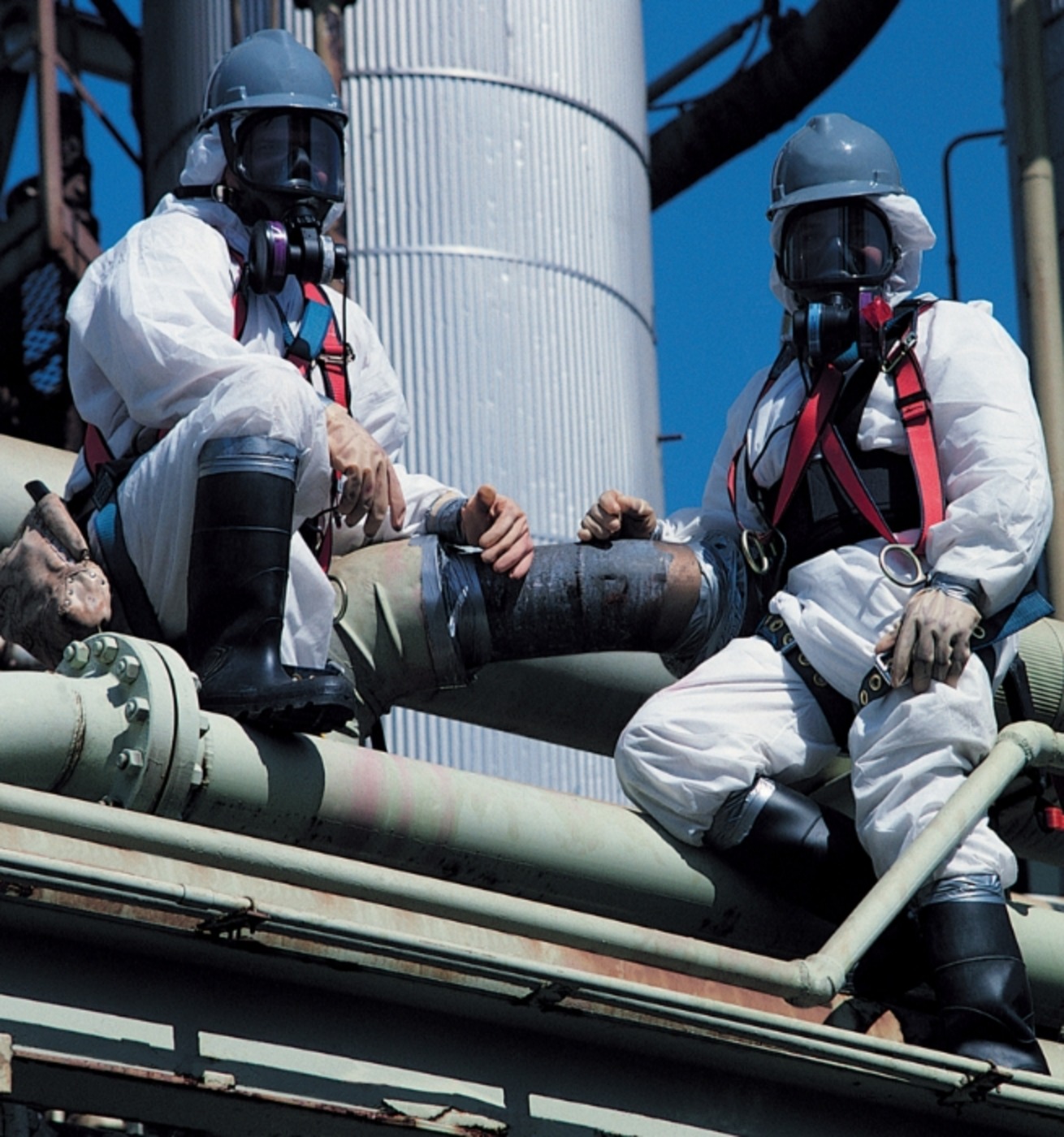
- Veiller à ce que les membres du personnel portent une combinaison de protection intégrale et un équipement respiratoire non motorisé couvrant la moitié du visage, à purification d’air, avec un filtre de classe 100, ou un équipement offrant une protection égale ou supérieure en cas d’utilisation d’un protecteur de mains. [Asbestos in the Workplace: A Guide to Removal of Friable Asbestos Containing Materials (2013), s. 3(1)]
- Veiller à ce que les membres du personnel portent une combinaison de protection intégrale (y compris une cagoule) et un appareil respiratoire à adduction d’air comprimé avec un filtre de classe 100, ou un équipement offrant une protection égale ou supérieure lorsqu’ils utilisent des méthodes d’enlèvement humide sans protecteur de mains. [Asbestos in the Workplace: A Guide to Removal of Friable Asbestos Containing Materials (2013), s. 3(2)]
- Lors de l’enlèvement à sec de l’amiante friable, veiller à : [Asbestos in the Workplace: A Guide to Removal of Friable Asbestos Containing Materials (2013), s. 3(3)]
- assurer la surveillance, selon les exigences décrites ci-dessous dans la section Contrôle et surveillance des poussières;
- s’assurer que les membres du personnel portent une combinaison de protection intégrale (y compris une cagoule) et utilisent un appareil respiratoire à adduction d’air comprimé avec filtre de classe 100 si l’exposition à l’amiante est inférieure à 100 fibres par centimètre cube (f/cc);
- s’assurer que les membres du personnel utilisent un appareil respiratoire à adduction d’air avec un facteur de protection assigné de 10 000 si l’exposition à l’amiante est de 100 f/cc ou plus.
- Se conformer à la dernière version de la norme CSA Z94.4, « Choix, utilisation et entretien des appareils de protection respiratoire », lorsqu’une protection respiratoire est requise, notamment : [Asbestos in the Workplace: A Guide to Removal of Friable Asbestos Containing Materials (2013), s. 3(4)]
- la sélection, l’utilisation, l’entretien et la mise à l’essai des appareils respiratoires;
- la formation des membres du personnel qui utilisent un appareil respiratoire;
- s’assurer que les membres du personnel qui portent des appareils respiratoires ajustés sont rasés de près;
- l’essai d’ajustement quantitatif si un facteur de protection de 1 000 est requis pour un appareil respiratoire à épuration d’air à masque complet.
Contrôle et surveillance des poussières
L’employeur est tenu de faire ce qui suit :
- N’utiliser l’enlèvement à sec des MCA friables que si l’enlèvement humide est dangereux pour les membres du personnel. [Asbestos in the Workplace: A Guide to Removal of Friable Asbestos Containing Materials (2013), s. 4(1)]
- Prélever quotidiennement des échantillons personnels de fibres d’amiante en suspension dans l’air pendant l’enlèvement à sec, lorsqu’un appareil respiratoire à adduction d’air comprimé avec filtre de classe 100 est utilisé, afin de vérifier que la concentration de fibres en suspension dans l’air ne dépasse pas 100 f/cc. [Asbestos in the Workplace: A Guide to Removal of Friable Asbestos Containing Materials (2013), s. 4(2)]
- Prélever des échantillons quotidiens pendant le désamiantage à sec ou humide si aucun protecteur de mains n’est utilisé et que l’air de l’intérieur de l’enceinte est évacué vers une zone intérieure à l’extérieur de l’enceinte. Si la concentration dépasse 0,01 f/cc dans une zone intérieure à l’extérieur de l’enceinte, il doit prendre des mesures immédiates. [Asbestos in the Workplace: A Guide to Removal of Friable Asbestos Containing Materials (2013), s. 4(3)]
- Recueillir, préparer, analyser et déclarer les échantillons conformément à : [Asbestos in the Workplace: A Guide to Removal of Friable Asbestos Containing Materials (2013), s. 4(4)]
- la méthode 7400 du National Institute for Occupational Safety and Health américain (NIOSH), Version 2: Asbestos and Other Fibers by PCM (15 août 1994) [en anglais seulement];
- la méthode 7402 du NIOSH, Version 2: Asbestos by TEM (15 août 1994) [en anglais seulement];
- ou une méthode équivalente avec un niveau de précision et d’exactitude équivalent ou supérieur.
- Analyser les échantillons dans un délai de 24 heures. Si une augmentation de la concentration dans l’air est détectée, l’équipement de protection individuelle doit être revu et mis à niveau. [Asbestos in the Workplace: A Guide to Removal of Friable Asbestos Containing Materials (2013), s. 4(5)]
- Aviser le CMSST ou le porte-parole de la santé et de la sécurité de l’essai conformément aux exigences de l’article 35 de la loi sur la santé et la sécurité au travail (Occupational Health and Safety Act). [Asbestos in the Workplace: A Guide to Removal of Friable Asbestos Containing Materials (2013), s. 4(5)]
- Procéder à un contrôle des fibres d’amiante en suspension dans l’air pendant l’essai de dégagement, tel qu’il est indiqué ci-dessous dans la section Inspection visuelle et essai de dégagement. [Asbestos in the Workplace: A Guide to Removal of Friable Asbestos Containing Materials (2013), s. 4(6)]
- Tenir un dossier de toutes les données d’échantillonnage de l’air conformément au paragraphe 1.15(1) du règlement sur la santé et la sécurité en milieu de travail (Workplace Health and Safety Regulations). [Asbestos in the Workplace: A Guide to Removal of Friable Asbestos Containing Materials (2013), s. 4(7)]]
Hygiène personnelle
L’employeur est tenu de faire ce qui suit :
- Lors de l’utilisation d’un protecteur de mains, s’assurer que toutes les combinaisons ou les autres vêtements contaminés sont enlevés et préparés en vue d’être jetés avant d’enlever le masque ou de quitter la zone de travail. [Asbestos in the Workplace: A Guide to Removal of Friable Asbestos Containing Materials (2013), s. 5(1)]
- Si des MCA friables sont retirés sans protecteur de mains, veiller à ce que : [Asbestos in the Workplace: A Guide to Removal of Friable Asbestos Containing Materials (2013), s. 5(2)]
- les vêtements de ville soient retirés et laissés dans la zone propre de l’enceinte;
- des vêtements de protection soient portés dans la zone de travail;
- les combinaisons et autres vêtements contaminés soient enlevés et préparés en vue d’être éliminés ou nettoyés avant d’enlever tout appareil respiratoire ou de quitter la zone de travail;
- une douche avec de l’eau courante chaude et froide soit fournie;
- les appareils respiratoires soient portés jusqu’à ce que les cheveux et le corps soient complètement mouillés.
- Prévoir des toilettes dans ou près de la salle blanche et du côté décontaminé de l’enceinte. [Asbestos in the Workplace: A Guide to Removal of Friable Asbestos Containing Materials (2013), s. 5(3)]
- Ne pas autoriser les membres du personnel à manger, boire ou fumer dans la zone de travail. [Asbestos in the Workplace: A Guide to Removal of Friable Asbestos Containing Materials (2013), s. 5(4)]
- Prendre des dispositions pour que les combinaisons lavables soient stockées, transportées et nettoyées en toute sécurité afin de s’assurer qu’aucun MCA ne quitte le site d’assainissement sans être contrôlé. [Asbestos in the Workplace: A Guide to Removal of Friable Asbestos Containing Materials (2013), s. 5(5)]
Élimination des déchets
L’employeur est tenu de faire ce qui suit :
- Éliminer les déchets d’amiante conformément aux exigences provinciales ou fédérales applicables en la matière. [Asbestos in the Workplace: A Guide to Removal of Friable Asbestos Containing Materials (2013), s. 6(1)]
- Veiller à ce que tous les déchets d’amiante soient placés dans des sacs en polyéthylène de 0,15 mm assortis d’étiquettes d’avertissement imprimées indiquant la présence d’amiante. Tous les sacs doivent être fermés et l’extérieur doit être nettoyé avant qu’ils soient emportés dans la zone de décontamination. [Asbestos in the Workplace: A Guide to Removal of Friable Asbestos Containing Materials (2013), s. 6(2)-(3)]
- S’assurer que tous les sacs contenant des déchets d’amiante sont placés dans un deuxième sac ou fût de stockage étiqueté à 0,15 mm. Le matériau peut être emballé selon une autre méthode que le ministère de l’Environnement approuve par écrit, puis envoyé à un site d’élimination approuvé. [Asbestos in the Workplace: A Guide to Removal of Friable Asbestos Containing Materials (2013), s. 6(4)]
- Informer l’employeur ou le porte-parole du site d’élimination de tout matériau suspecté de contenir de l’amiante. [Asbestos in the Workplace: A Guide to Removal of Friable Asbestos Containing Materials (2013), s. 6(5)]
Nettoyage
L’employeur est tenu de faire ce qui suit :
- S’assurer que les surfaces intérieures de l’enceinte et tous les outils et équipements sont nettoyés après l’enlèvement des MCA friables par essuyage humide ou par aspiration avec un aspirateur ayant fait l’objet d’une mise à l’essai réussie de son filtre HEPA après chaque changement de filtre et au moins une fois par an. [Asbestos in the Workplace: A Guide to Removal of Friable Asbestos Containing Materials (2013), s. 7(1)]
- Sceller adéquatement tout MCA résiduel avec un agent d’encapsulation approprié qui demeurera à l’intérieur de la zone de travail après l’enlèvement de l’enceinte. [Asbestos in the Workplace: A Guide to Removal of Friable Asbestos Containing Materials (2013), s. 7(2)]
Inspection visuelle et essai de dégagement
L’employeur est tenu de faire ce qui suit :
- Demander à une personne compétente d’inspecter visuellement la zone de travail à l’intérieur de l’enceinte après le nettoyage et avant d’enlever une enceinte qui n’est pas un protecteur de mains pour s’assurer que les fibres d’amiante ne seront pas en suspension dans l’air. [Asbestos in the Workplace: A Guide to Removal of Friable Asbestos Containing Materials (2013), s. 8(1)]
- Tenir un dossier des inspections comme l’exige le paragraphe 1.15(2) du règlement sur la santé et la sécurité en milieu de travail (Workplace Health and Safety Regulations). [Asbestos in the Workplace: A Guide to Removal of Friable Asbestos Containing Materials (2013), s. 8(1)]
- Utiliser un équipement à air forcé, tel qu’un souffleur de feuilles, pendant au moins 5 minutes par 90 m2 de surface de plancher pour déloger les fibres des murs, des plafonds, des planchers, des rebords et des autres surfaces à l’intérieur de l’enceinte avant de procéder à l’échantillonnage des fibres d’amiante en suspension dans l’air à l’intérieur de l’enceinte. [Asbestos in the Workplace: A Guide to Removal of Friable Asbestos Containing Materials (2013), s. 8(2)]
- Prélever au moins un échantillon pour les fibres d’amiante en suspension dans l’air pour chaque zone de 270 m3 de confinement. [Asbestos in the Workplace: A Guide to Removal of Friable Asbestos Containing Materials (2013), s. 8(3)]
- Recueillir, préparer, analyser et déclarer les échantillons conformément à: [Asbestos in the Workplace: A Guide to Removal of Friable Asbestos Containing Materials (2013), s. 8(4)]
- la méthode 7400 du National Institute for Occupational Safety and Health américain (NIOSH), Version 2: Asbestos and Other Fibers by PCM (15 août 1994) [en anglais seulement];
- la méthode 7402 du NIOSH, Version 2: Asbestos by TEM (15 août 1994) [en anglais seulement];
- ou une méthode équivalente avec un niveau de précision et d’exactitude équivalent ou supérieur.
- S’assurer que la concentration en suspension dans l’air de chaque échantillon d’aérosol ne dépasse pas 0,01 f/cc d’air. L’essai de dégagement ne peut pas être considéré comme étant réussi si l’analyse révèle une concentration supérieure à 0,01 f/cc. [Asbestos in the Workplace: A Guide to Removal of Friable Asbestos Containing Materials (2013), s. 8(5)]
- Demander à une personne compétente d’examiner les résultats de l’inspection visuelle et des échantillons d’air avant de déterminer si l’enceinte peut être enlevée. [Asbestos in the Workplace: A Guide to Removal of Friable Asbestos Containing Materials (2013), s. 8(6)]
- Répéter les étapes de nettoyage ci-dessus si la personne compétente indique que l’inspection visuelle ou l’essai de dégagement a échoué. [Asbestos in the Workplace: A Guide to Removal of Friable Asbestos Containing Materials (2013), s. 8(7)]
- Enlever l’enceinte uniquement une fois qu’une personne compétente a déterminé que la zone a réussi l’essai de dégagement et l’inspection visuelle. [Asbestos in the Workplace: A Guide to Removal of Friable Asbestos Containing Materials (2013), s. 8(8)]
Législation
OCCUPATIONAL HEALTH AND SAFETY ACT
S.N.S. 1996, c. 7
Section 3
3. In this Act,
(a) "aggrieved person" means an employer, constructor, contractor, employee, self-employed person, owner, supplier, provider of an occupational health or safety service, architect, engineer or union at a workplace who is directly affected by an order or decision;
(b) "analyst" means a person appointed as an analyst by the Minister pursuant to this Act;
(c) "Board" means the Labour Board established under the Labour Board Act;
(d) "committee" means a joint occupational health and safety committee established pursuant to this Act;
(e) "compliance notice" means a response, in writing, to an order of an officer, describing the extent to which the person against whom the order was made has complied with each item identified in the order;
(f) "constructor" means a person who contracts for work on a project or who undertakes work on a project himself or herself;
(g) "contractor" means a person who contracts for work to be performed at the premises of the person contracting to have the work performed, but does not include a dependent contractor or a constructor;
(h) "contracts for work" includes contracting to perform work and contracting to have work performed;
(i) "Council" means the Occupational Health and Safety Advisory Council established pursuant to this Act;
(j) "dependent contractor" means a person, whether or not employed under a contract of employment and whether or not furnishing the person's own tools, vehicles, equipment, machinery, material or any other thing, who performs work or services for another on such terms and conditions that the person is
(i) in a position of economic dependence upon the other,
(ii) under an obligation to perform duties mainly for the other, and
(iii) in a relationship with the other more closely resembling that of an employee than an independent contractor;
(k) "Deputy Minister of Labour and Advanced Education" includes a person designated by the Deputy Minister of Labour and Advanced Education to act in the stead of the Deputy Minister;
(l) "Director" means the Executive Director of Occupational Health and Safety or any person designated by the Executive Director pursuant to this Act to act on behalf of the Executive Director;
(m) "Director of Labour Standards" means the Director of Labour Standards under the Labour Standards Code;
(n) "Division" means the Occupational Health and Safety Division of the Department of Labour and Advanced Education;
(o) "employee" means a person who is employed to do work and includes a dependent contractor;
(p) "employer" means a person who employs one or more employees or contracts for the services of one or more employees, and includes a constructor, contractor or subcontractor;
(q) "former Act" means Chapter 320 of the Revised Statutes, 1989, the Occupational Health and Safety Act;
(r) "health and safety" includes both physical and psychological health and safety;
(s) "Minister" means the Minister of Labour and Advanced Education;
(t) "occupation" means any employment, business, calling or pursuit;
(u) "officer" means an occupational health and safety officer appointed pursuant to this Act and includes the Director;
(v) "owner" includes a trustee, receiver, mortgagee in possession, tenant, lessee or occupier of lands or premises used as a workplace and a person who acts for, or on behalf of, an owner as an agent or delegate;
(w) "police officer" means
(i) a member of the Royal Canadian Mounted Police, or
(ii) a member or chief officer of a police force appointed pursuant to the Police Act;
(x) "policy" means an occupational health and safety policy made pursuant to this Act;
(y) "practicable" means possible, given current knowledge, technology and invention;
(z) "program" means an occupational health and safety program required pursuant to this Act, unless the context otherwise requires;
(aa) "project" means a construction project, and includes
(i) the construction, erection, excavation, renovation, repair, alteration or demolition of any structure, building, tunnel or work and the preparatory work of land clearing or earth moving, and
(ii) work of any nature or kind designated by the Director as a project;
(ab) "reasonably practicable" means practicable unless the person on whom a duty is placed can show that there is a gross disproportion between the benefit of the duty and the cost, in time, trouble and money, of the measures to secure the duty;
(ac) "regularly employed" includes seasonal employment with a predictably recurring period of employment that exceeds four weeks, unless otherwise established by regulation or ordered by an officer;
(aca) "repeatedly" means occurring more than once within the preceding three year period;
(ad) "representative" means a health and safety representative selected pursuant to this Act;
(ae) "self-employed person" means a person who is engaged in an occupation on that person's own behalf and includes a person or persons operating a sole proprietorship but does not include a dependent contractor;
(aea) "serious injury" means an injury that endangers life or causes permanent injury;
(af) "supplier" means a person who manufactures, supplies, sells, leases, distributes or installs any tool, equipment, machine or device or any biological, chemical or physical agent to be used at or near a workplace;
(ag) "union" includes a trade union as defined in the Trade Union Act that has the status of bargaining agent under that Act in respect of any bargaining unit at a workplace, and includes an organization representing employees where the organization has exclusive bargaining rights under any other Act in respect of the employees;
(ah) "workplace" means any place where an employee or a self-employed person is or is likely to be engaged in any occupation and includes any vehicle or mobile equipment used or likely to be used by an employee or a self-employed person in an occupation.
[S.N.S. 2000, c. 28, s. 86; 2010, c. 66, s. 2; 2010, c. 37, s. 117; 2011, c. 24, s. 2; 2016, c. 14, s. 1; 2024, c. 10, s. 11]
Occupational Safety General Regulations
N.S. Reg. 44/99
Part 1 Title and Definitions
Section 2 Definitions
2. In these regulations,
(a) "Act" means the Occupational Health and Safety Act ;
(aa) "adequate" means sufficient to protect a person from injury or damage to health;
(b) "ALI" means the Automotive Lift Institute;
(ba) "angle of repose" means the angle with the horizontal at which material will no longer flow freely;
(c) "ANSI" means the American National Standards Institute;
(ca) "approved" means approved by the Department or by an agency or authority designated or selected by the Department to make approvals;
(d) "ASME" means the American Society of Mechanical Engineers;
(e) "ASTM" means the American Society for Testing and Materials;
(ea) "CGA" means the Compressed Gas Association;
(f) "CGSB" means the Canadian General Standards Board;
(g) "competent person" means a person who is
(i) qualified because of their knowledge, training and experience to do the assigned work in a manner that ensures the health and safety of every person in the workplace, and
(ii) knowledgeable about the provisions of the Act and regulations that apply to the assigned work, and about potential or actual danger to health or safety associated with the assigned work;
(ga) "compressed air" means air mechanically raised to a pressure higher than atmospheric pressure;
(h) "CSA" means the Canadian Standards Association;
(i) "demolition" means the destruction or removal of all, or part, of an existing building or structure;
(ia) "Department" means the Department of Labour and Advanced Education;
(j) "designated" means, in relation to an employer, appointed in writing by the employer;
(k) "electrical installation" means the wires, machinery, apparatus, appliances, devices, material and equipment used or intended for use for the generation, transmission, distribution, supply and use of electrical power or energy, and includes a power line and power line equipment;
(l) "engineer" means a person who is registered as a member or licensed to practise under the Engineering Profession Act and is competent to do the work being performed;
(m) "firefighter" means
(i) an employee who provides fire suppression services to the public from a fire department within a municipality or local service district, or
(ii) an industrial firefighter;
(n) "guardrail" means a fall protection system consisting of vertical and horizontal members that
(i) are capable of withstanding concentrated forces, as prescribed in these regulations or an applicable standard,
(ii) warn of a fall hazard, and
(iii) reduce the risk of a fall;
(o) "hazardous substance" means chemical or biological material, dangerous goods within the meaning of the Dangerous Goods Transportation Act or a controlled product within the meaning of the Hazardous Products Act (Canada) that is likely to, because of its harmful nature, cause injury or damage to the health or safety of a person exposed to it;
(p) "hoist" means a device or equipment and its structure used for lifting or lowering material, including cranes, an automotive lift, a winch, a chain fall or other similar device, but does not include a lift truck, a power operated elevating work platform, a device to which the Elevators and Lifts Act applies or a hoist that operates in a shaft in the underground at a mine;
(pa) "ITSDF" means the Industrial Truck Standards Development Foundation;
(q) "industrial firefighter" means an employee who
(i) is designated to fight fires at the employee's place of employment, and
(ii) is employed by an employer who does not, in the normal course of its business, provide fire suppression services to the public;
(qa) "latest version" means, in relation to a standard or other publication, the latest edition of the standard or publication as supplemented, amended, added to, replaced or superseded;
(r) "lift truck" means a lift truck as defined in the latest version of ANSI standard ANSI/ITSDF B56.1, "Safety Standard for Low Lift and High Lift Trucks";
(s) "locked out" means to have
(i) isolated the energy source or sources from a machine, equipment, tool or electrical installation,
(ii) dissipated any residual energy in a system, and
(iii) secured the isolation of the energy source or sources by an inhibiting device that is operated by a key or other process,
and to have performed a "lock-out" has a similar meaning;
(t) "machine" Repealed. [N.S. Reg. 52/2000, s. 1]
(u) "manufacturer's specifications" means
(i) the written instructions of a manufacturer of a machine, material, tool or equipment that outline the manner in which the machine, material, tool or equipment is to be erected, installed, assembled, started, operated, used, handled, stored, stopped, adjusted, carried, maintained, repaired, inspected, serviced, tested, cleaned or dismantled, and
(ii) a manufacturer's instruction, operating or maintenance manual and drawings respecting a machine, tool or equipment;
(ua) "mobile crane" means a mobile crane to which the latest version of CSA standard CSA Z150 , "Safety Code on Mobile Cranes" applies;
(v) "NFPA" means the National Fire Protection Association;
(va) "overhead crane" means any mechanical device or structure that is used to raise, lower and move material that travels overhead and that incorporates a
(i) power driven drum, bridge and cable or rope,
(ii) single or multiple girder, and
(iii) moveable bridge carrying a moveable or fixed hoisting mechanism,
but does not include wall cranes, cantilever gantry cranes and semi-gantry cranes;
(vb) "personal flotation device" means personal protective equipment that is capable of supporting a person with their head above water without the direct effort of the person wearing the equipment;
(w) "power line" means the above-ground or underground wiring that is used to distribute electricity;
(x) "power line equipment" means the components that are required to distribute electricity by means of a power line;
(y) "power operated elevating work platform" means a mobile horizontal working surface that provides access and support to a person at a workplace, and that is elevated and lowered by means of a mechanism and [that complies with] Part 23: Scaffolds and Other Elevated Work Platforms, of the Workplace Health and Safety Regulations made under the Act, including a standard listed in subsection (4) thereof;
(z) "powered mobile equipment" means self-propelled equipment that is designed to operate on land in conditions other than a public highway, but does not include equipment primarily designed to transport persons, a lift truck or a power operated elevating work platform;
(aa) "SAE" means the Society of Automotive Engineers;
(ab) "structural fire-fighting" means the activities of rescue, fire suppression and conservation of property from fires involving buildings, structures, vehicles, vessels, aircraft or other large objects constructed by human effort;
(ac) "surface mine" means a work or undertaking, other than a trench, for the purpose of opening up, proving, removing or extracting any metallic or non-metallic mineral or mineral bearing substance, rock, earth, clay, sand or gravel by means of an open excavation, and includes a pit or quarry;
(ad) "tower crane" means any mechanical device or structure that
(i) incorporates a power-driven drum and cable or rope and a vertical mast or tower and a jib,
(ii) is of the traveling, fixed or climbing type, and
(iii) is used exclusively for raising, lowering and moving material;
(ae)"trench" means an excavation in which the excavation depth exceeds the excavation width;
(af) "work area" means a location at the workplace at which an employee or self-employed person is or is likely to be working;
(ag) "worked" means drilled, blasted, extracted, excavated, loaded or subjected to other similar work.
[N.S. Reg. 52/2000, s. 1; 151/2003; 53/2013, ss. 1, 93]
Asbestos in the Workplace: A Guide to Removal of Friable Asbestos Containing Materials
Revised November 21, 2013
Section 1 Site Preparation
1. Site Preparation
(1) Where removal of friable asbestos is performed, a glove bag must be used, or a temporary enclosure must be constructed to prevent asbestos fibres from leaving the work area.
(2) An enclosure used during the removal of friable asbestos must
(a) be constructed of polyethylene sheeting that is at least 0.15 millimetres thick,
(b) be labeled with signs to restrict entry to authorized personnel,
(c) include provisions for an airlock, clean room, shower area, decontamination room, and holding area for waste materials;
(d) be maintained under negative pressure using HEPA negative air units, 24-hours per day for the duration of the work and until the area has passed clearance testing after cleanup;
(e) have a minimum of 4 air changes per hour or a static pressure of negative five (-5) Pascal’s relative to pressure outside the enclosure, as measured inside the enclosure at a point furthest from the exhaust fan; and
(f) have at least one observation window made of a transparent material that, where reasonably practicable, enables a person who is located outside of the enclosure to see work activity that is taking place inside the enclosure.
Section 2 Ventilation - HEPA Testing
2. Ventilation - HEPA Testing
(1) Aside from specific HEPA negative air units that are used to exhaust air from inside the enclosure, all ventilation systems that service the work area must be isolated from the enclosure to prevent contamination by
(a) sealing ventilation duct supply and return air openings with poly sheeting; and
(b) where reasonably practicable, turning off the air handling systems that service ithe work area.
(2) All vacuums and HEPA negative air units that are used to exhaust air from inside the enclosure to any area outside of the enclosure must successfully pass a HEPA unit test
(a) after a HEPA filter is replaced; and
(b) at least once every 12 months.
(3) All HEPA negative air units that are used to exhaust air from inside the enclosure to an indoor-area that is outside of the enclosure must successfully pass a HEPA unit test, onsite, immediately prior to use at a given site.
(4) HEPA testing must include
(a) a visual inspection to identify any apparent damage and to examine the integrity of the seal in the filter frame; and
(b) a filter testing procedure using dioctyl phthalate (DOP) or other appropriate challenge test material to verify the unit is functioning as the manufacturer intended.
(5) HEPA testing records must be maintained, including the name of the testing agency, the name of the tester, the date of testing, and the result of the test.
(6) The employer is also required to maintain all HEPA filters in ventilation systems and vacuum cleaners in accordance with manufacturer's instructions, or as specified by a professional engineer, to ensure that they remain effective.
Section 3 Personal Protective Equipment
3. Personal Protective Equipment
(1) Where a glove bag is used, employees must wear full-body protective coveralls and a half-facepiece, air-purifying, non-powered respirator equipped with a 100-class filter, or equipment offering equal or greater protection.
(2) Where wet removal of friable asbestos is to be performed without the use of a glove bag, employees must wear full-body protective coveralls (including hood) and a full-facepiece powered air-purifying respirator equipped with a 100-class filter, or equipment offering equal or greater protection.
(3) Where dry removal of friable asbestos is to be performed
(a) monitoring must be conducted in accordance with Section 4;
(b) employees must wear full-body protective coveralls (including hood) and are permitted to use a full-facepiece powered air-purifying respirator equipped with a 100-class filter unless the results from monitoring during removal indicate that an employee’s exposure is greater than 100 fibres per cubic centimeter; and
(c) where exposures are 100 fibres per cubic centimeter or greater, an atmospheresupplying respirator that has an assigned protection factor of 10000 is required.
(4) Where respiratory protection is required, the employer must ensure compliance with the latest version of CSA Standard Z94.4 , "Selection, Use, and Care of Respirators" for the selection, use, maintenance, and testing of a respirator, as well as the training of employees who use a respirator. This standard specifies that employees who wear a tight-fitting respirator must be clean-shaven, and that quantitative fit-testing must be carried out if a protection factor of 1000 is to be achieved with a full-facepiece powered air-purifying respirator.
Section 4 Dust Control and Monitoring
4. Dust Control and Monitoring
(1) Dry removal of friable asbestos-containing materials may be performed only where wet removal is shown to present a hazard to employees.
(2) When dry removal is conducted and where a full-facepiece powered air-purifying respirator equipped with a 100-class filter is used for worker protection, personal sampling for airborne asbestos fibres must be conducted on a daily basis during removal to verify the airborne concentrations do not exceed 100 fibres per cubic centimeter.
(3) Where dry or wet asbestos removal is conducted, a glove bag is not used, and the air from inside the enclosure is exhausted to an indoor area that is outside of the enclosure,
(a) daily sampling for airborne asbestos fibres must be conducted outside of the enclosure.
(b) immediate action must be taken if the concentration of airborne asbestos is found to exceed 0.01 fibres per cubic centimeter of air in an indoor area that is outside of the enclosure.
(4) All samples for airborne asbestos fibres must be collected, prepared, analyzed, and reported in accordance with the NIOSH Method 7400, Issue 2: Asbestos and Other Fibers by PCM (August 15, 1994), or NIOSH Method 7402, Issue 2: Asbestos by TEM (August 15, 1994), or by a method that provides for an equivalent or greater level of precision and accuracy.
(5) Samples must be analyzed within 24 hours and the committee or representative must be notified of the testing, in accordance with Section 35 of the Occupational Health and Safety Act. Where an increase in airborne concentration is detected, the personal protective equipment required must be reviewed and upgraded in accordance with this document.
(6) Monitoring for airborne asbestos fibres must be conducted during clearance testing, as specified in Section 8.
(7) The employer must maintain a record of all air sampling data in accordance with subsection 1.15(1) of the Workplace Health and Safety Regulations.
Section 5 Personal Hygiene
5. Personal Hygiene
(1) Where a glove bag is used, coveralls and other contaminated clothing must be removed and prepared for disposal prior to removing any respirator or leaving the work area.
(2) Where removal of friable asbestos-containing material is performed without a glove bag
(a) street clothes must be removed and left in the clean area of the enclosure;
(b) protective clothing, as set out in Section 3, must be worn in the work area;
(c) coveralls and other contaminated clothing must be removed and prepared for disposal or cleaning prior to removing any respirator or leaving the work area;
(d) a shower with both warm and cold running water must be provided; and
(e) respirators must be worn until the hair and body have been thoroughly wetted.
(3) Toilet facilities must be provided in or near the clean room on the decontaminated side of the enclosure.
(4) No eating, drinking, or smoking is permitted in the work area.
(5) Where washable coveralls are used, arrangements for the proper storage, transportation and cleaning must be made and followed to ensure asbestos material does not leave the remediation site uncontrolled.
Section 6 Waste Disposal
6. Waste Disposal
(1) Asbestos waste must be disposed of in accordance with all applicable provincial or federal asbestos disposal requirements.
(2) All asbestos waste must be placed in 0.15 millimetre polyethylene bags with printed asbestos warning labels.
(3) Bags containing asbestos waste must be closed, and the outside cleaned before being taken to the decontamination area.
(4) Bags containing asbestos waste must be placed within a second, 0.15 millimetre, labeled bag or a labeled drum. Alternatively, the material must be packaged and placed in accordance with a method approved in writing by the Department of Environment and sent to an approved disposal site.
(5) When asbestos waste is brought to a disposal site, the employer or representative at the disposal site must be notified of any materials that are suspected to contain asbestos.
Section 7 Clean-Up
7. Clean-Up
(1) Following the removal of friable asbestos containing materials the work area, the inner surfaces of the enclosure, as well as all tools and equipment, must be cleaned by
(a) damp wiping; or
(b) vacuuming with a vacuum that has successfully passed a HEPA unit test in accordance with the HEPA unit test after each filter change, and at least once per year.
(2) Any residual asbestos containing materials that will remain inside the work area after the enclosure is removed must be adequately sealed with a suitable encapsulant.
Section 8 Visual Inspection & Clearance Test
8. Visual Inspection & Clearance Test
(1) Following the clean-up requirements noted in Section 7, and prior to removing an enclosure that is not a glove bag, a visual inspection of the work area inside the enclosure must be carried out by a competent person to ensure that there is no reasonable possibility of asbestos fibres becoming airborne. The employer must maintain a record of these inspections in accordance with subsection 1.15(2) of the Workplace Health and Safety Regulations.
(2) Before sampling for airborne asbestos fibres inside the enclosure, forced air equipment, such as a leaf blower, must be operated for at least 5 minutes per 90 square metres of floor area to dislodge fibres from any walls, ceilings, floors, ledges, and other surfaces inside the enclosure.
(3) At least one sample for airborne asbestos fibres must be collected for every 270 cubic metres of containment.
(4) All samples for airborne asbestos fibres must be collected, prepared, analyzed, and reported in accordance with the NIOSH Method 7400, Issue 2: Asbestos and Other Fibers by PCM (August 15, 1994), or NIOSH Method 7402, Issue 2: Asbestos by TEM (August 15, 1994), or by a method that provides for an equivalent or greater level of precision and accuracy.
(5) The clearance test cannot be passed unless the analysis of each aerosol sample collected indicates that the airborne concentration does not exceed 0.01 asbestos fibres per cubic centimeter of air.
(6) A competent person must review the results of the visual inspection specified in Section 8(1), and the results of the air sampling specified in Sections 8(3) and 8(4), before determining whether the enclosure can be removed.
(7) If a competent person indicates that the visual inspection or clearance test is not passed, then the clean-up steps specified in Section 7 must be repeated, and the clearance test must be repeated.
(8) If a competent person indicates that the clearance test and visual inspection by a competent person are passed, then the enclosure may be removed.
Asbestos in the Workplace: A Guide to Assessment & Management of Asbestos in the Workplace
Revised November 21, 2013
Section 1 Specific Requirements
1. Assessment of Materials
(1) The owner of a building must ensure that
(1) the building is assessed by a competent person to determine if any asbestos containing materials are present;
(2) the assessment includes the collection of a representative number of bulk samples of suspect materials (see Table 1);
(3) each bulk sample is analyzed by an appropriate laboratory analytical method; and
(4) the type of asbestos and percent composition of asbestos in each sample is indicated in the analysis report.
(An assessment could be ordered under Section 52 of the Occupational Health and Safety Act.)
Bulk Material Samples1
| Type of material | Size of area of homogeneous material | Minimum number of bulk material samples to be collected |
| Surfacing material, including but not limited to material that is applied by spraying, troweling or otherwise, such as acoustical plaster on ceilings, and fireproofing materials on structural members. | Less than 90 square metres (<1000 ft2) | 3 |
| 90 or more square metres, but less than 450 square metres (1000-5000 ft2) | 5 | |
| 450 or more square metres (>5000 ft2) | 7 | |
| Thermal insulation, except thermal insulation that has been sprayed or troweled. | Any size | 3 |
| Less than 2 linear metres or 0.5 square metres | 1 | |
| Other material. | Any size | 3 |
Section 2 Inventory of Samples
2. Inventory of Samples
(1) The owner of the building shall ensure that
(a) a written inventory is created to document the locations where each bulk sample has been collected and the results of all bulk sample analyses;
(b) the inventory is maintained as long as asbestos containing materials are present in the workplace;
(c) each employer whose workplace is in the building is informed regarding the presence of asbestos containing material in relevant areas of the building; and
(d) each employer whose workplace is in the building is provided with a reasonable opportunity to view the inventory.
(2) The employer must ensure that the committee or the representative, if any, is informed regarding the presence of asbestos containing material in relevant areas of the building in accordance with Section 35 of the Occupational Health and Safety Act.
(An assessment could be ordered under Section 52 of the Occupational Health and Safety Act.)
Section 3 Temporary Measures to Manage Immediate Risk of Asbestos Exposure
3. Temporary Measures to Manage Immediate Risk of Asbestos Exposure
(1) Where asbestos containing material is present in a workplace, and there is an immediate risk of exposure, the owner and any employer whose workplace is in the building must
(a) inform occupants, employees, contractors, dependent contractors, and constructors who face an immediate risk of excessive exposure regarding the
i. locations where the potential for asbestos exposure exists in the workplace;
ii. potential health risks posed by asbestos exposure; and
iii. restrictions and precautions that must be followed to minimize the risk caused by the presence of asbestos containing material in the workplace; and
(b) take immediate action to temporarily prevent asbestos exposure (e.g. use a physical barrier to prevent access to damaged asbestos containing material); and
(c) ensure that any asbestos containing materials that may result in an immediate risk of asbestos exposure are removed by a competent person who has been trained in the applicable safe work procedures.
(Temporary measures could be ordered under Section 19 (for Owners) or Section 13 (for Employers) of the Occupational Health and Safety Act)
Section 4 Asbestos Management Plan
4. Asbestos Management Plan
Owner Responsibilities
(1) Where asbestos containing material is present in a workplace and any immediate risk has been addressed in accordance with Section 3 of this document, the owner of the building must
(a) ensure that a written asbestos management plan
i. is developed and maintained as long as an asbestos containing material is present in the workplace; and
ii. lists the areas of priority, and measures that will be taken to prevent asbestos exposure in the workplace (such as removal, enclosure, encapsulation, or use of a physical barrier to prevent unauthorized individuals from accessing the area where asbestos containing material exists);
(b) consult the most recent version of the OHS Division document entitled "Asbestos in the Workplace: A Guide to Removal of Friable Asbestos Containing Material" where the removal of friable asbestos containing material is planned;
(c) inform any employers whose workplace is in the building, and any contractors or constructors, for which the owner has responsibility, of the
i. locations where the potential for asbestos exposure exists in the workplace;
ii. potential health risks posed by asbestos exposure;
iii. restrictions or precautions that must be followed to minimize the risk associated with the presence of asbestos containing material in the workplace; and
iv. reporting procedures to be followed in the event that a material that is believed to contain asbestos is damaged;
(d) ensure that any contractor or self-employed person who the owner requires to work in the building is trained in safe work procedures for activities that may require contact with asbestos containing materials, including the proper selection, use and care of required personal protective equipment, the use of isolation techniques as needed, and the use of the appropriate equipment for the work to be done;
(e) conduct regular inspections of asbestos containing materials to check for signs of damage that could result in a release of asbestos fibres; and
(f) maintain written records of communication, training, and inspections for a period of two years or for as long as they are relevant.
Employer Responsibilities
(2) Where asbestos containing material is present in a workplace the employer of that workplace must
(a) consult the committee or representative, if any, regarding the development of the asbestos management plan;
(b) inform employees, contractors, dependent contractors, and constructors, for which they have responsibility, of the
i. locations where the potential for asbestos exposure exists in the workplace;
ii. potential health risks posed by asbestos exposure;
iii. restrictions or precautions that must be followed to minimize the risk associated with the presence of asbestos containing material in the workplace; and
iv. reporting procedures to be followed in the event that a material that is believed to contain asbestos is damaged;
(c) ensure employees are trained in safe work procedures for activities that may require contact with asbestos containing materials, including the proper selection, use and care of required personal protective equipment, the use of isolation techniques as needed, and the use of the appropriate equipment for the work to be done; and
(d) maintain written records of communication and training for a period of two years or for as long as they are relevant.
(An assessment management plan could be ordered under Section 19 (for Owners) or Section 13 (for Employers) of the Occupational Health and Safety Act)