


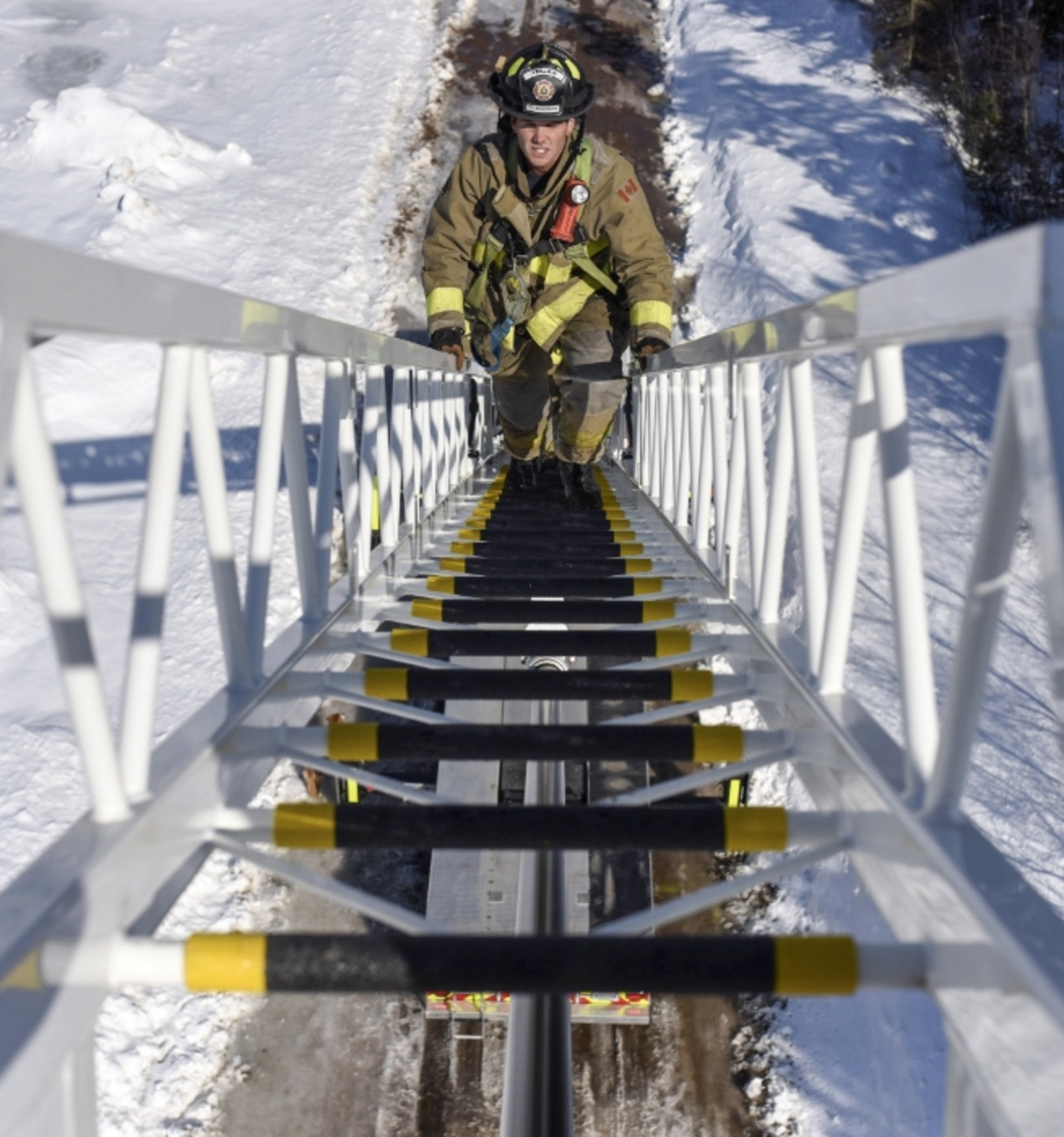
Le saviez-vous?
Saviez-vous que les échelles doivent être inspectées avant leur utilisation et annuellement, tout comme votre harnais anti-chute?
Résumé
Les échelles sont couramment utilisées sur les lieux de travail. Il existe des échelles portatives et fixes, qui peuvent être adaptées aux différentes exigences du travail. Les échelles permettent aux membres du personnel d’accéder rapidement à des hauteurs élevées et présentent l’avantage d’être portatives et abordables. Les risques courants liés au travail avec des échelles sont les chutes, les risques ergonomiques (force et posture), les risques énergétiques (gravité et cinétique), les pratiques de travail dangereuses et les risques potentiels liés à la hauteur. Les accidents impliquant des échelles sont généralement dus : à l’utilisation d’une échelle inadaptée à la tâche à accomplir; à l’utilisation d’échelles défectueuses ou en mauvais état; à une attention inadaptée ou à une utilisation inadéquate, notamment un positionnement incorrect, une fixation inadéquate de l’échelle, une mauvaise assise, etc.; et à une formation insuffisante des membres du personnel à l’entretien, à l’utilisation et au travail à partir d’échelles en toute sécurité. Parmi les considérations importantes en matière de sécurité, citons le choix de l’échelle appropriée, son utilisation correcte, sa construction, son entretien et sa maintenance conformément aux spécifications de l’entreprise fabricante et les inspections avant utilisation. Pour veiller à l’utilisation générale sécuritaire des échelles, l’employeur est tenu de faire ce qui suit :
- S’assurer qu’une personne utilisant une échelle fixe ou portable [N.S. Reg. 44/99, s. 148(2)]
- fait face à l’échelle lorsqu’elle l’utilise;
- maintient un contact adéquat, par exemple en utilisant le contact à trois points pour maintenir un contact adéquat avec l’échelle lorsqu’elle se trouve à plus de 1 m au dessus d’une surface sûre*;
- se tient au centre entre les rails latéraux*;
- lorsque l’échelle est un escabeau, ne se tient pas sur la tablette, le sommet ou la marche supérieure de l’escabeau*;
- lorsque l’échelle n’est pas un escabeau, ne travaille pas depuis les trois échelons supérieurs*.
- Retirer de la circulation les échelles dont les échelons sont lâches, cassés ou manquants, les rails latéraux fendus ou d’autres défauts qui peuvent être dangereux. [N.S. Reg. 44/99, s. 148(4)]
- Fournir une protection contre les chutes lorsque le travail doit être effectué à partir d’une échelle et que la personne est incapable de maintenir un contact adéquat avec l’échelle tout en effectuant le travail. [N.S. Reg. 52/2013, s. 21.2(4)(b)]
- Veiller à ce qu’une autre mesure de contrôle soit utilisée pour réduire le risque de chute lorsqu’il n’est pas possible d’utiliser une protection individuelle contre les chutes et que le membre du personnel n’est pas en mesure de maintenir un contact adéquat avec l’échelle pendant l’exécution du travail. [N.S. Reg. 52/2013, s. 21.2(5)]
Pour une échelle portative, l’employeur est tenu de faire ce qui suit :
- S’assurer qu’elle peut supporter quatre fois la charge maximale susceptible d’être exercée sur elle; qu’elle est maintenue propre, sans graisse, huile ou autres substances susceptibles de provoquer un glissement; et qu’elle est maintenue dans un état sûr. [N.S. Reg. 44/99, s. 148(1)]
- S’assurer qu’une personne compétente l’inspecte avant chaque utilisation, et au moins une fois par an, afin qu’elle soit dans un état adéquat et considéré comme sécuritaire. [N.S. Reg. 44/99, s. 148(1)(d)]
- S’assurer qu’une échelle dont l’état est jugé inadéquat après une inspection n’est pas utilisée. [N.S. Reg. 44/99, s. 148(1)(e)]
- Prévoir deux couloirs d’échelles distincts lorsqu’une échelle portative est utilisée comme moyen d’accès ou de sortie pour des hauteurs supérieures à six mètres et pour sept personnes ou plus. [N.S. Reg. 44/99, s. 152]
- Lorsqu’une échelle portative est utilisée, s’assurer de ce qui suit : [N.S. Reg. 44/99, s. 151]
- Elle est placée sur une base solide et protégée de tout mouvement.
- Pour y accéder ou en sortir, elle est dotée de rampes latérales qui s’étendent à au moins 1 m au-dessus de toute plate-forme ou de tout palier, et présente un espace libre d’au moins 150 mm entre elle et la structure porteuse, sauf dans la zone où l’échelle s’appuie sur la structure.
- S’il s’agit d’un escabeau, celui-ci est muni de pieds solidement maintenus en position au moyen d’étriers métalliques ou d’un support rigide équivalent.
- Elle n’est pas raccordée à une autre échelle, à moins que la section raccordée ne soit contreventée de manière à ce que les montants latéraux raccordés soient aussi solides que les montants latéraux d’origine.
- Elle n’est pas placée devant ou contre une porte qui peut être ouverte vers l’échelle, à moins que la porte soit bloquée en position ouverte, verrouillée ou gardée.
- Elle n’est pas utilisée comme un échafaudage, une rampe ou un support pour un tel revêtement de sol.
- Elle n’est pas placée sur une boîte, un tonneau, un échafaudage ou toute autre base instable.
- Elle n’est pas attachée à une autre échelle pour en accroître la longueur.
- Elle n’est pas située dans une cage d’ascenseur ou un puits de levage lorsque cet espace est utilisé pour le levage.
- Pour une échelle portative de fabrication commerciale, s’assurer de ce qui suit : [N.S. Reg. 44/99, s. 150]
- Elle est conforme à la norme CSA Z11 « Échelles portatives ».
- Les échelles portatives de grade 3, telles que décrites dans la norme CSA Z11, ne sont pas utilisées.
- S’il s’agit d’une échelle à coulisse, vérifier qu’il y a un chevauchement adéquat entre les sections de l’échelle; que les verrous sont enclenchés avant que l’on monte sur l’échelle à coulisse; et qu’elle est non conductrice lorsqu’il y a un risque de contact avec des conducteurs électriques sous tension. [N.S. Reg. 44/99, s. 150(3)]
- Pour une échelle portative en bois non fabriquée dans le commerce, s’assurer de ce qui suit : [N.S. Reg. 44/99, s. 149]
- Elle est faite d’épinette, de pin ou de sapin no 1 ou no 2, classé selon la norme CSA 0141, « Softwood Lumber » (Bois d’œuvre résineux – en anglais seulement) [ou d’autres bois équivalents en matière de sécurité].
- Elle n’est pas peinte, bien qu’elle puisse être protégée à l’aide d’une couche protectrice transparente.
- Elle ne dépasse pas une longueur de 9 m (s’il s’agit d’une échelle simple).
- Les échelons ne comportent pas de nœuds; ils sont conçus pour supporter une charge de 200 kg placée au centre; ils sont uniformément espacés avec une hauteur maximale de 300 mm; ils sont fixés de chaque côté de la traverse latérale par au moins trois vis ou clous en spirale de longueur adéquate ou par des fixations offrant une résistance équivalente ou supérieure; et ils sont cloués aux traverses latérales.
- Elle a des rails latéraux qui :
- - présentent une largeur libre uniforme entre eux d’au moins 300 mm pour les échelles de 3 m de long ou moins, et augmentant de 1 mm de largeur pour chaque 100 mm au-delà de 3 m*;
- - lorsque l’échelle a une longueur inférieure à 5,7 m, ses dimensions sont d’au moins 50 mm d’épaisseur et d’au moins 100 mm de largeur, et lorsque l’échelle a une longueur égale ou supérieure à 5,7 m, ses dimensions sont d’au moins 50 mm d’épaisseur et d’au moins 150 mm de largeur*.
- Elle ne se balance pas ou ne s’affaisse pas, ce qui la rendrait dangereuse. [N.S. Reg. 44/99, s. 149(2)]
- Si elle est conçue et utilisée précisément pour la récolte dans des arbres fruitiers, elle est construite, érigée, utilisée et entretenue à cette fin. [N.S. Reg. 44/99, s. 149(3)]
- Lorsqu’une échelle portative est utilisée pour la lutte contre les incendies de structures, l’employeur doit s’assurer qu’elle est conforme ou supérieure à la norme NFPA 1931, « Standard on Design of and Design Verification Tests for Fire Department Ground Ladders » (Norme sur la conception des échelles portatives des services incendie et sur les tests de vérification de leur conception – en anglais seulement), et qu’elle est utilisée, entretenue et testée conformément à la norme NFPA 1932, « Standard on Use, Maintenance and Service Testing of Fire Department Ground Ladders » (Norme sur l’utilisation, la maintenance et la mise à l’essai du fonctionnement des échelles portatives des services incendie – en anglais seulement). [N.S. Reg. 44/99, s. 200]
-
- sont habillés de tous côtés et sans arêtes vives;
Pour une échelle fixe, l’employeur doit s’assurer qu’elle est conçue, construite, installée et entretenue conformément à la dernière version de la norme ANSI A14.3 « American National Standard for Ladders – Fixed – Safety Requirements » (Norme nationale américaine pour les échelles – Fixes – Exigences en matière de sécurité – en anglais seulement). [N.S. Reg. 44/99, s. 147]
Le membre du personnel doit faire ce qui suit :
- Ne pas utiliser une échelle portative dont l’état est inadéquat selon une personne compétente. [N.S. Reg. 44/99, s. 148(1)(e)]
- Faire face à l’échelle lorsqu’il monte ou descend. [N.S. Reg. 44/99, s. 148(2)(a)]
- Maintenir en permanence un contact adéquat, par exemple un contact à trois points sur une échelle portative. [N.S. Reg. 44/99, s. 148(2)(b)]
- Ne pas travailler à partir des trois échelons supérieurs de l’échelle portable ou de la marche supérieure d’un escabeau. [N.S. Reg. 44/99, s. 148(2)(d) and(e)]
- Ne pas raccorder les échelles entre elles. [N.S. Reg. 44/99, s. 151(2)(a)]
- Ne pas placer une échelle devant ou contre une porte, sauf si la porte est bloquée, verrouillée ou gardée. [N.S. Reg. 44/99, s. 151(2)(b)]
- Ne pas utiliser une échelle comme un échafaudage, une rampe ou pour soutenir un plancher d’échafaudage. [N.S. Reg. 44/99, s. 151(2)(c)]
- Ne pas placer une échelle sur une boîte, un tonneau, un échafaudage ou toute autre base instable. [N.S. Reg. 44/99, s. 151(2)(d)]
- Ne pas trop se pencher lorsqu’il est sur une échelle, et déplacer un escabeau si nécessaire.
- Porter un équipement personnel de protection contre les chutes lorsqu’il ne peut pas maintenir un contact adéquat avec l’échelle pendant l’exécution du travail. [N.S. Reg. 52/2013, s. 21.2(4)(b)]
* Cette exigence ne s’applique pas aux membres du service incendie engagés dans la lutte contre les incendies structurels ou le sauvetage. [N.S. Reg. 44/99, s. 148(3)]
Législation
Occupational Safety General Regulations
N.S. Reg. 44/99
Part 1 Title and Definitions
Section 2 Definitions
2. In these regulations,
(a) "Act" means the Occupational Health and Safety Act ;
(aa) "adequate" means sufficient to protect a person from injury or damage to health;
(b) "ALI" means the Automotive Lift Institute;
(ba) "angle of repose" means the angle with the horizontal at which material will no longer flow freely;
(c) "ANSI" means the American National Standards Institute;
(ca) "approved" means approved by the Department or by an agency or authority designated or selected by the Department to make approvals;
(d) "ASME" means the American Society of Mechanical Engineers;
(e) "ASTM" means the American Society for Testing and Materials;
(ea) "CGA" means the Compressed Gas Association;
(f) "CGSB" means the Canadian General Standards Board;
(g) "competent person" means a person who is
(i) qualified because of their knowledge, training and experience to do the assigned work in a manner that ensures the health and safety of every person in the workplace, and
(ii) knowledgeable about the provisions of the Act and regulations that apply to the assigned work, and about potential or actual danger to health or safety associated with the assigned work;
(ga) "compressed air" means air mechanically raised to a pressure higher than atmospheric pressure;
(h) "CSA" means the Canadian Standards Association;
(i) "demolition" means the destruction or removal of all, or part, of an existing building or structure;
(ia) "Department" means the Department of Labour and Advanced Education;
(j) "designated" means, in relation to an employer, appointed in writing by the employer;
(k) "electrical installation" means the wires, machinery, apparatus, appliances, devices, material and equipment used or intended for use for the generation, transmission, distribution, supply and use of electrical power or energy, and includes a power line and power line equipment;
(l) "engineer" means a person who is registered as a member or licensed to practise under the Engineering Profession Act and is competent to do the work being performed;
(m) "firefighter" means
(i) an employee who provides fire suppression services to the public from a fire department within a municipality or local service district, or
(ii) an industrial firefighter;
(n) "guardrail" means a fall protection system consisting of vertical and horizontal members that
(i) are capable of withstanding concentrated forces, as prescribed in these regulations or an applicable standard,
(ii) warn of a fall hazard, and
(iii) reduce the risk of a fall;
(o) "hazardous substance" means chemical or biological material, dangerous goods within the meaning of the Dangerous Goods Transportation Act or a controlled product within the meaning of the Hazardous Products Act (Canada) that is likely to, because of its harmful nature, cause injury or damage to the health or safety of a person exposed to it;
(p) "hoist" means a device or equipment and its structure used for lifting or lowering material, including cranes, an automotive lift, a winch, a chain fall or other similar device, but does not include a lift truck, a power operated elevating work platform, a device to which the Elevators and Lifts Act applies or a hoist that operates in a shaft in the underground at a mine;
(pa) "ITSDF" means the Industrial Truck Standards Development Foundation;
(q) "industrial firefighter" means an employee who
(i) is designated to fight fires at the employee's place of employment, and
(ii) is employed by an employer who does not, in the normal course of its business, provide fire suppression services to the public;
(qa) "latest version" means, in relation to a standard or other publication, the latest edition of the standard or publication as supplemented, amended, added to, replaced or superseded;
(r) "lift truck" means a lift truck as defined in the latest version of ANSI standard ANSI/ITSDF B56.1, "Safety Standard for Low Lift and High Lift Trucks";
(s) "locked out" means to have
(i) isolated the energy source or sources from a machine, equipment, tool or electrical installation,
(ii) dissipated any residual energy in a system, and
(iii) secured the isolation of the energy source or sources by an inhibiting device that is operated by a key or other process,
and to have performed a "lock-out" has a similar meaning;
(t) "machine" Repealed. [N.S. Reg. 52/2000, s. 1]
(u) "manufacturer's specifications" means
(i) the written instructions of a manufacturer of a machine, material, tool or equipment that outline the manner in which the machine, material, tool or equipment is to be erected, installed, assembled, started, operated, used, handled, stored, stopped, adjusted, carried, maintained, repaired, inspected, serviced, tested, cleaned or dismantled, and
(ii) a manufacturer's instruction, operating or maintenance manual and drawings respecting a machine, tool or equipment;
(ua) "mobile crane" means a mobile crane to which the latest version of CSA standard CSA Z150 , "Safety Code on Mobile Cranes" applies;
(v) "NFPA" means the National Fire Protection Association;
(va) "overhead crane" means any mechanical device or structure that is used to raise, lower and move material that travels overhead and that incorporates a
(i) power driven drum, bridge and cable or rope,
(ii) single or multiple girder, and
(iii) moveable bridge carrying a moveable or fixed hoisting mechanism,
but does not include wall cranes, cantilever gantry cranes and semi-gantry cranes;
(vb) "personal flotation device" means personal protective equipment that is capable of supporting a person with their head above water without the direct effort of the person wearing the equipment;
(w) "power line" means the above-ground or underground wiring that is used to distribute electricity;
(x) "power line equipment" means the components that are required to distribute electricity by means of a power line;
(y) "power operated elevating work platform" means a mobile horizontal working surface that provides access and support to a person at a workplace, and that is elevated and lowered by means of a mechanism and [that complies with] Part 23: Scaffolds and Other Elevated Work Platforms, of the Workplace Health and Safety Regulations made under the Act, including a standard listed in subsection (4) thereof;
(z) "powered mobile equipment" means self-propelled equipment that is designed to operate on land in conditions other than a public highway, but does not include equipment primarily designed to transport persons, a lift truck or a power operated elevating work platform;
(aa) "SAE" means the Society of Automotive Engineers;
(ab) "structural fire-fighting" means the activities of rescue, fire suppression and conservation of property from fires involving buildings, structures, vehicles, vessels, aircraft or other large objects constructed by human effort;
(ac) "surface mine" means a work or undertaking, other than a trench, for the purpose of opening up, proving, removing or extracting any metallic or non-metallic mineral or mineral bearing substance, rock, earth, clay, sand or gravel by means of an open excavation, and includes a pit or quarry;
(ad) "tower crane" means any mechanical device or structure that
(i) incorporates a power-driven drum and cable or rope and a vertical mast or tower and a jib,
(ii) is of the traveling, fixed or climbing type, and
(iii) is used exclusively for raising, lowering and moving material;
(ae)"trench" means an excavation in which the excavation depth exceeds the excavation width;
(af) "work area" means a location at the workplace at which an employee or self-employed person is or is likely to be working;
(ag) "worked" means drilled, blasted, extracted, excavated, loaded or subjected to other similar work.
[N.S. Reg. 52/2000, s. 1; 151/2003; 53/2013, ss. 1, 93]
Part 13 Premises and Building Safety, Construction and Demolition
Section 147 Ladders
147. An employer shall ensure that a fixed ladder is designed, constructed, installed and maintained in accordance with the latest version of ANSI standard A14.3 "American National Standard for Ladders - Fixed - Safety Requirements".
[N.S. Reg. 53/2013, s. 64
Section 148
148. (1) An employer shall ensure that a portable ladder used at a workplace is
(a) able to withstand 4 times the maximum load likely to be imposed;
(b) clean and free of grease, oil or other substances that may cause slipping;
(c) maintained in a safe condition;
(d) inspected at all of the following times by a competent person to ensure all components are in an adequate condition and the ladder is safe to use:
(i) before each use,
(ii) annually;
(e) not used, where the inspection required in clause (d) identifies an inadequate condition with the ladder.
(2) An employer shall ensure that a person using a fixed or portable ladder shall
(a) face the ladder when climbing or descending;
(b) when more than 1 m above a safe surface, maintain adequate contact with the ladder, such as 3-point contact;
(c) where the person is standing on a ladder, stand in the centre between the side rails;
(d) where the ladder is a step ladder, not stand on the material shelf, the top or the top step of the ladder; and
(e) where the ladder is not a step ladder, not work from the top three rungs of the ladder.
(3) Clauses (2)(b), (c), (d) and (e) do not apply to a firefighter engaged in structural firefighting or rescue.
(4) An employer shall remove a ladder from service when it has loose, broken or missing rungs, split side rails or other defects that may be hazardous to the safety of a person at the workplace.
[N.S. Reg. 52/2000, s. 80; 53/2013, s. 65]
Section 149
149. (1) An employer shall ensure that a wooden portable ladder that is not commercially manufactured
(a) is made of No. 1 or No. 2 spruce, pine, or fir as graded according to the latest version of CSA O141 , "Softwood Lumber", or other lumber that provides an equivalent level of safety;
(b) is not painted other than by being preserved with a transparent protective coating;
(c) if a single ladder, does not exceed 9 m in length;
(d) has rungs that are
(i) free of knots,
(ii) designed to carry a load of 200 kg placed at the centre,
(iii) uniformly spaced with a maximum rise of 300 mm,
(iv) secured to each side of the side rail of the ladder by at least 3 screws or spiral nails of adequate length or by attachments giving equivalent or better strength, and
(v) subject to subsection (3), cleated to the side rails; and
(e) has side rails that
(i) are dressed on all sides and without sharp edges,
(ii) subject to subsection (3), have a uniform clear width between them of not less than 300 mm for ladders 3 m in length or less, and increasing 1 mm in width for each 100 mm in excess of 3 m,
(iii) where the ladder is less than 5.7 m in length, have dimensions of at least 50 mm thick by at least 100 mm wide, and
(iv) subject to subsection (3), where the ladder is 5.7 m or greater in length, have dimensions of at least 50 mm thick by at least 150 mm wide.
(2) An employer shall ensure that a ladder does not sway or sag in an unsafe manner.
(3) An employer shall ensure that a portable ladder that is designed specifically for the purpose of harvesting fruit from trees and is used only for that purpose, is erected, constructed, maintained and used so as to be adequate for that purpose.
(4) Subclause. (1)(d)(v) and subclauses. (1)(e)(ii) and (iv) do not apply to a ladder that conforms to the requirements of subsection (3).
[N.S. Reg. 52/2000, s. 81; 53/2013, s. 66]
Section 150
150. (1) An employer shall ensure that a portable ladder that is commercially manufactured is designed", manufactured and maintained in accordance with the latest version of CSA standard Z11 , "Portable Ladders".
(2) Despite subsection. (1), an employer shall ensure that Grade 3 portable ladders, as described in any edition of CSA standard CSA Z11, "Portable Ladders", are not used at a workplace.
(3) An employer shall ensure that a commercially manufactured portable ladder
(a) where it is an extension ladder, maintains an adequate overlap between the sections of the ladder;
(b) has locks engaged before the extension ladder is climbed; and
(c) where there is a risk of contact with live electrical conductors, is non-conductive.
[N.S. Reg. 52/2000, s. 82; 53/2013, s. 67]
Section 151
151. (1) An employer shall ensure that when a portable ladder is used
(a) it is placed on a firm footing;
(b) it is secured in an adequate manner against movement as soon as reasonably practicable;
(c) as a means of access or exit, it
(i) has side rails that extend at least 1 m above any platform or landing, and
(ii) has a clearance of at least 150 mm between it and the supporting structure, except in the area where the ladder is supported against the structure; and
(d) as a step ladder, it has legs securely held in position by means of metal braces or an equivalent rigid support.
(2) An employer shall ensure that, when a portable ladder is used, it is not
(a) spliced together with another ladder unless the spliced section is braced so that the spliced side rails are as strong as the original side rails;
(b) placed in front of or against a door that can be opened towards the ladder unless the door is blocked in the open position, locked or guarded;
(c) used as a scaffold, ramp, or as a support for such flooring;
(d) placed on a box, barrel, scaffold, or other unstable base;
(e) lashed to another ladder to increase its length; or
(f) located in an elevator shaft or hoistway when such space is being used for hoisting.
[N.S. Reg. 52/2000, s. 83]
Section 152
152. Where a portable ladder is used as a means of access or exit for a height greater than 6 m and for 7 or more persons, an employer shall provide 2 separate lines of ladders.
Part 16 Equipment for Firefighters
Section 200 Portable ladders
200. (1) Where a portable ground ladder is used for structural fire-fighting, an employer shall ensure that it complies with or exceeds the latest version of NFPA standard NFPA 1931, "Standard on Design of and Design Verification Tests for Fire Department Ground Ladders", and is used, maintained and tested in accordance with the latest version of NFPA standard NFPA 1932, "Standard on Use, Maintenance and Service Testing of Fire Department Ground Ladders".
(2) Where a portable ground ladder is used in subsection (1), an employer is exempt from the requirement in subsection 150(1).
[N.S. Reg. 52/2000, s. 105; 53/2013, s. 90]
Workplace Health and Safety Regulations
N.S. Reg. 52/2013
Part 21 FALL PROTECTION
Section 21.2 Fall protection required
21.2 (1) Except as provided in subsections (3) to (5), fall protection is required if a person is at risk of falling from a work area where the fall distance is
(a) 3 m or more above the nearest safe surface or water;
(b) less than 3 m and the work area is above 1 of the following:
(i) a surface or thing that could cause injury to the person on contact that is worse than an injury from landing on a solid, flat surface,
(ii) exposed hazardous material, such as in an open tank, pit or vat.
(2) If fall protection is required, an employer must ensure that at least 1 of the following means of fall protection is used, as appropriate in the circumstances:
(a) a guardrail;
(b) temporary flooring;
(c) a personnel safety net;
(d) a travel restraint system;
(e) a fall-arrest system.
(3) Fall protection is not required for a person who is entering or exiting a work area by a safe means of access and egress.
(4) Fall protection is required only where reasonably practicable and to the extent reasonably practicable in any of the following circumstances:
(a) if work must be performed on or from a vehicle, rail car or other mobile equipment;
(b) if it is not reasonably practicable to perform work other than from a ladder and it is not reasonably practicable for the person performing the work to maintain adequate contact with the ladder while performing the work;
(c) if the density of tree branches prevents an arborist from crotching.
(5) If it is not reasonably practicable to use fall protection in the circumstances described in subsection (4), an employer must ensure that an alternate control measure is used to reduce, to the extent reasonably practicable, the risk of a fall.