



Did you know?
In Canada, mining contributes to the livelihood of many families and communities and our national economy. Those who work at pits and quarries in Nova Scotia face many health and safety hazards. Hazard identification and risk control measures are critical to the health and safety of those who work at a pit or quarry.
Summary
A pit is a workplace where loose materials, such as sand and gravel, are excavated. A quarry is a workplace where solid rock, such as lime or granite, is extracted. Pits and quarries have many workplace health and safety hazards, including heavy mobile equipment, vehicle traffic, dust, noise, heat, UV radiation from sunlight, vibration, electrical hazards, mechanical hazards, conveyors, rock crushing equipment, and sometimes explosives for blasting.
A key way to prevent incidents and create a safe working environment while working at a pit or quarry is to identify hazards, evaluate risk, and select effective control measures. Examples of risk control measures include fall protection, equipment maintenance, dust control, hazard awareness training, and personal protective equipment.
Surface mine marking location and control of entry
- An employer must ensure a surface mine is clearly and adequately marked and identified, and securely protected from unauthorized entry, where the mine presents a hazard by reason of its depth, openings, or approaches that are not clearly visible, and the hazard caused by natural topographical features within 600 metres of the working face. [N.S. Reg. 44/99, s. 175]
Notice of operation at a surface mine
- Where activities in a surface mine are initially started, or when activities are resumed after no operation for 4 months or more, notification of the director in writing, at least two weeks before the start of operations, with the notice specifying the geographic location of the mine and the estimated start-up date and period of operation. [N.S. Reg. 44/99, s. 182]
Blasting
An employer must make sure that:
- Adequate warning procedure and a warning signal code are prominently displayed at a surface mine or quarry and easily accessible by all employees. [N.S. Reg. 89/2008, s. 67(2)]
Road and vehicle safety at a surface mine
An employer must make sure that:
- All roadways at the surface mine location are designed, constructed and maintained to minimize slipping and skidding vehicles. [N.S. Reg. 44/99, s. 176]
- Adequate shoulder barrier, design, construction, and maintenance to prevent vehicles from going off the road, where the edge of a regularly used road in a surface mine has a drop-off of greater than 3 metres and presents a hazard. [N.S. Reg. 44/99, s. 177]
- The grade on roadways in a surface mine does not exceed 12% on any 300 metres portion of the roadway, unless there is a written procedure for handling vehicle runaways, provision of runaway lanes, retardation barriers, adequate vehicle modification or vehicle manufacturer's specifications are followed. [N.S. Reg. 44/99, s. 178(1)]
- The roadway grade in a surface mine does not exceed 12% on a roadway length that exceeds 300 metres, in the absence of the manufacturer's specifications. [N.S. Reg. 44/99, s. 178(2)]
- High visibility clothing is provided for all pedestrians at a surface mine in the vicinity of operating mobile equipment, and the clothing is used according to CSA Standard Z96.1"Guideline on selection, use and care of high-visibility safety apparel," and CSA standard CSA Z96 "High-visibility safety apparel." [N.S. Reg. 44/99, s. 179]
- Adequate precautions are taken to prevent vehicle overturn, where excavated material from a surface mine is dumped from a vehicle onto a stockpile. [N.S. Reg. 44/99, s. 180]
Working face, benching, and unconsolidated overburden
An employer must make sure that:
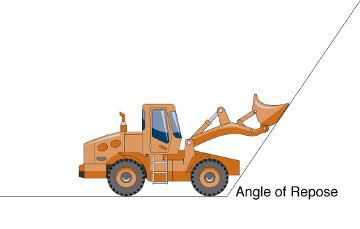
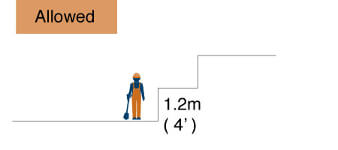
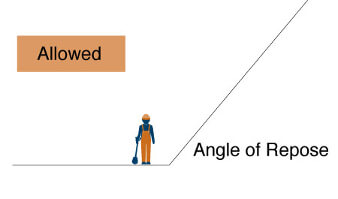
- Unconsolidated overburden at a surface mine is moved to a safe distance away from the edge to prevent material falling into the surface mine, is sloped to its angle of repose, and where materials are less than 7 metres away from the edge of a surface that is greater than 1.2 metres deep and when a person is or may be present, the approval of an engineer is required. [N.S. Reg. 44/99, s. 181]
- A competent person inspects the working face to make sure that it is adequate before any work is allowed to begin at or near a working face in a surface mine, and the competent person must record the results of the inspection in a daily examination and record book, and will record any hazardous occurrences. The competent person will also read the record in the daily examination and record book from the previous shift and sign it before work at the face begins for the next shift. [N.S. Reg. 44/99, s. 183]
- A surface mine is designed, constructed and maintained with a wall or working face having a vertical rise of no more than 20 metres for every horizontal run not less than 8 metres. [N.S. Reg. 44/99, s. 184(1)]
- Adequate benching of the wall or working face, where the wall or working face of a surface mine is 20 metres in height or less and where the working face cannot be excavated in a safe manner. [N.S. Reg. 44/99, s. 184(2)]
- Where a wall or working face of a surface mine is greater that 20 metres and not benched, that the wall or working face height has been deemed to be adequate by an engineer, extracted material is removed by equipment located at the top of the wall or working face, and in instances where work is required to be performed within a radius of 1.3 times the height of the wall or working face, that a procedure has been developed to ensure that the work is performed safely. [N.S. Reg. 44/99, s. 184(3)]
- No material is removed where a person is present in a surface mine, and they could potentially be struck by an object dislodged by the equipment. [N.S. Reg. 44/99, s. 184(4)]
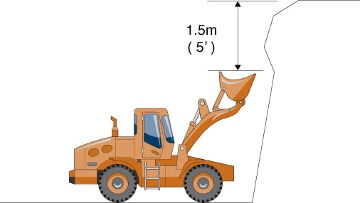
- The vertical height of any unconsolidated material is not more than 1.5 metres above the maximum reach of the equipment being used to remove the unconsolidated material, unless any work being done is done according to written specifications and a written safe work procedure, certified by an engineer, following consultation with the committee or representative. [N.S. Reg. 44/99, s. 185]
- Where material in a surface mine is being worked on by powered mobile equipment, the working face is sloped to a maximum grade of one unit of vertical rise for every equal unit of horizontal run during periods of inactivity that exceed a period of 4 months, the working face extends not more than 1.5 metres above the maximum reach of the equipment or the work is performed according to written specifications and a written safe work procedure certified by an engineer, following consultation with the committee or representative, if any. [N.S. Reg. 44/99, s. 186(1)(2)]
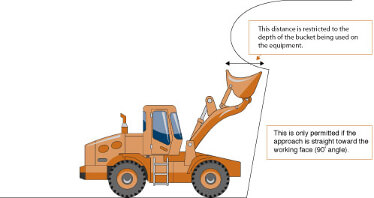
- Where undercutting or undermining work is done at the working face of a surface mine, using powered mobile equipment, undercutting, or undermining is restricted to the depth of the bucket of the powered mobile equipment; and allowed only when the approach by the operator of the powered mobile equipment is at a 90° angle to the working face, and the work is performed according to specifications and a written safe work procedure certified by a competent person in consultation with the committee, or representative, if any. [N.S. Reg. 44/99, s. 187]
- Where unconsolidated material is being worked in a surface mine by means other than powered mobile equipment, the working face is sloped at its angle of repose, the vertical portion of the working face does not exceed a maximum grade of one unit of vertical rise for every equal unit of horizontal run, or the work is performed according to written specifications and a written safe work procedure certified by an engineer, following consultation with the committee or representative, if any. [N.S. Reg. 44/99, s.188]
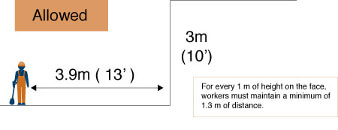
- No person comes closer to the working face than 1.3 times the height of the working face unless the working face is sloped at its angle of respose, the working face is benched to limit the vertical height of the working face to not more than 1.2 metres, and the grade above the horizontal portion does not exceed one unit of vertical rise for every equal unit of horizontal run; or the work is performed in accordance with written specifications and a written safe work procedure certified as adequate by an engineer, following consultation with the committee or representative, if any.[N.S. Reg. 44/99, s. 189].
202(a)
202(b)
Health and Safety hazards
Other hazards that are common at pits and quarries can be found on Nova SAFE, including:
- Blasting
- Confined spaces
- Conveyors
- Demolition
- Electrical safety - general
- Emergency eyewash and showers
- Excavation and trenches
- Fall protection
- Fire extinguishers
- First aid
- Harassment
- Heat stress and cold stress
- Hoists and mobile equipment
- Hot work (welding)
- Lock out
- Noise
- Personal protective equipment
- Radiation (UV from sunlight and welding)
- Sanitation and accommodation
- Silica dust
- Tools, grinders, and wheels
- Vibration
- Violence
- WHMIS
An employee must:
Legislation
Blasting Safety Regulations
N.S. Reg. 89/2008
Section 67 Warning signals
67. (1) A blaster must ensure that no charge is fired until sufficient audible and visual warning signals are given to all persons in or near an area where the blast may create a hazard.
(2) At a surface mine or quarry, an employer must ensure that a warning procedure and a warning signal code are posted in a prominent place in the workplace capable of being easily accessed by the employees.
Occupational Safety General Regulations
N.S. Reg. 44/99
Part 15 Surface Mine Workings
Section 174 Interpretation
174. In this Part, "working face" means an area in a surface mine where consolidated or unconsolidated material is worked.
[N.S. Reg. 52/2000, s. 89]
Section 175 Marking location and control of entry
175. An employer shall ensure that a surface mine is
(a) marked and identified in an adequate manner; and
(b) securely protected from inadvertent entry by a person where
(i) the surface mine constitutes a hazard by reason of its depth,
(ii) the approaches to or openings of the surface mine are not readily visible, or
(iii) the hazard caused by the surface mine is greater than the hazard caused by natural topographical features within 600 m of the working face.
Section 176 Roadways and vehicles
176. An employer shall ensure that a roadway at a surface mine used for the purpose of moving material to, from, or within a surface mine is designed, constructed and maintained
(a) to minimize hazards caused by slipping or skidding of vehicles;
(b) to enable vehicles to pass each other safely where the vehicles are required to pass each other, and with sufficient width to accommodate the proposed traffic; and
(c) so that grades do not exceed the design capacity of vehicles that are used on the roadway.
Section 177
177. Where, at the edge of a regularly used roadway in a surface mine, a drop-off greater than 3 m creates a hazard, an employer shall ensure that an adequate shoulder barrier is designed, constructed and maintained to prevent vehicles from inadvertently going off the road.
[N.S. Reg. 52/2000, s. 90]
Section 178
178. (1) An employer shall ensure that the grade on roadways in a surface mine does not exceed 12% on any 300 m portion of the roadway unless
(a) a written procedure for handling vehicle runaways has been prepared;
(b) where reasonably practicable, runaway lanes, retardation barriers or vehicle modifications are adequately in place; and
(c) the employer ensures that the vehicle manufacturer's specifications are followed.
(2) Where no manufacturer's specifications are available for a vehicle used on a roadway in a surface mine, an employer shall ensure that the grade on roadways in a surface mine does not exceed 12% on a roadway length that exceeds 300 m.
[N.S. Reg. 52/2000, s. 91]
Section 179
179. An employer must ensure that every person who is a pedestrian at a surface mine in an area of operating mobile equipment wears high-visibility apparel that is in accordance with all of the following:
(a) for the selection, use and care of the apparel, the latest version of CSA standard CSA Z96.1 , "Guideline on selection, use and care of high-visibility safety apparel";
(b) for the design and performance of the apparel, the latest version of CSA standard CSA Z96 , "High-visibility safety apparel".
[N.S. Reg. 52/2000, s. 92; 53/2013, s. 74]
Section 180
180. Where material excavated from a surface mine is dumped from a vehicle onto a stockpile, an employer shall ensure that adequate precautions are taken to ensure that the vehicle does not overturn.
Section 181 Overburden
181. An employer shall ensure that unconsolidated overburden at a surface mine
(a) is moved a sufficient distance away from the edge of the surface mine to prevent the overburden from falling into the surface mine;
(b) if less than 7 m away from the edge of a surface mine that is greater than 1.2 m deep and in which a person is or may be present, is approved by an engineer to ensure that the distance is adequate to prevent the overburden from falling into the surface mine; and
(c) is sloped to its angle of repose.
[N.S. Reg. 52/2000, s. 93]
Section 182 Notice of operation
182. When activities in a surface mine are initially started, or when activities are resumed after a cessation of operation of 4 months or more, an employer shall
(a) notify the Director in writing of the intention to begin or resume operations in the surface mine at least 2 weeks before the operations are to begin or resume;
(b) specify in the written notice to the Director the geographic location of the surface mine; and
(c) state the estimated start-up date and period of operation.
Section 183 Inspections
183. (1) No person shall begin work, other than at a stockpile, at or near a working face in a surface mine at the beginning of each operating shift until a competent person inspects the working face to ensure that the working face is adequate.
(2) The competent person referred to in subsection. (1) shall record the results of the inspection required by subsection. (1) in a daily examination and record book and shall record all unusual occurrences or hazards.
(3) The competent person referred to in subsection. (1) shall read the record in the daily examination and record book made for the previous shift and sign it before work at the face begins on the next shift.
(4) An employer shall make available the daily examination and record book referred to in subsections (2) and (3) on request to the committee or the representative, if any.
[N.S. Reg. 52/2000, s. 94; 53/2013, s. 75]
Section 184 Wall or working face
184. (1) Subject to subsection (3), where a wall or working face of a surface mine is greater than 20 m in height, an employer shall ensure that the surface mine is designed, constructed and maintained with the wall or working face benched and having a vertical rise not in excess of 20 m for every horizontal run not less than 8 m.
(2) Where a wall or working face of a surface mine is 20 m in height or less and the wall or working face cannot be excavated in a safe manner, an employer shall ensure that the wall or working face is adequately benched to ensure the work can be performed in a safe manner.
(3) Where a wall or working face of a surface mine is greater than 20 m in height and it is not benched in accordance with subsection. (1), an employer shall ensure that
(a) an engineer has certified the wall or working face height as adequate;
(b) subject to subsection (4), material extracted is removed by means of equipment located at the top of the wall or working face; or
(c) when work is required to be performed within a radius of 1.3 times the height of the wall or working face, a procedure is established to ensure the work is performed safely.
(4) An employer shall ensure that no material is removed in accordance with clause (3)(b) where a person is present in a surface mine in an area where they could be struck by an object dislodged by the equipment.
[N.S. Reg. 52/2000, ss. 95, 96; 53/2013, s. 76]
Section 185 Work procedures
185. Where unconsolidated material is being worked or removed, an employer shall ensure that the vertical height of the unconsolidated material is not more than 1.5 m above the maximum reach of the equipment being used to work or remove the unconsolidated material, unless the work is done in accordance with written specifications and a written safe work procedure certified by an engineer, following consultation with the committee or representative, if any.
(a) - (b) Repealed. [N.S. Reg. 53/2013, s. 77]
[N.S. Reg. 52/2000, s. 97; 53/2013, s. 77]
Section 186
186. (1) Where material in a surface mine is being worked by means of powered mobile equipment, an employer shall ensure that the working face is sloped to a maximum grade of one unit of vertical rise for every equal unit of horizontal run during periods of inactivity that exceed a period of 4 months.
(2) Where material in a surface mine is being worked by means of powered mobile equipment, an employer shall ensure that
(a) the working face extends not more than 1.5 m above the maximum reach of the equipment in use; or
(b) the work is performed in accordance with written specifications and a written safe work procedure certified by an engineer, following consultation with the committee or representative, if any.
(i) - (ii) Repealed. [N.S. Reg. 53/2013, s. 78]
[N.S. Reg. 52/2000, s. 98]
Section 187
187. Where undercutting or undermining is performed at the working face of a surface mine by means of powered mobile equipment, an employer shall ensure that the undercutting or undermining is
(a) restricted to the depth of the bucket of the powered mobile equipment; and
(b) permitted only when
(i) the approach by the operator of the powered mobile equipment is at a 90o angle to the working face; and
(ii) the work is performed in accordance with specifications and a written safe work procedure certified by a competent person in consultation with the committee, or representative, if any.
[N.S. Reg. 52/2000, s. 99]
Section 188
188. Where unconsolidated material in a surface mine is being worked by means other than powered mobile equipment, an employer shall ensure that
(a) the working face is sloped at its angle of repose;
(b) the vertical portion of the working face does not exceed a maximum grade of one unit of vertical rise for every equal unit of horizontal run; or
(c) the work is performed in accordance with written specifications and a written safe work procedure certified by an engineer, following consultation with the committee or representative, if any.
(i) - (ii) Repealed. [N.S. Reg. 53/2013, s. 79]
[N.S. Reg. 52/2000, s. 100; 53/2013, s. 79]
Section 189
189. Where unconsolidated material is being worked at a working face, an employer shall ensure that no person comes closer to the working face than 1.3 times the height of the working face, unless
(a) the working face is sloped at its angle of repose;
(b) the working face is benched to limit the vertical height of the working face to not more than 1.2 m and the grade above the horizontal portion does not exceed one unit of vertical rise for every equal unit of horizontal run; or
(c) the work is performed in accordance with written specifications and a written safe work procedure certified as adequate by an engineer, following consultation with the committee or representative, if any.
(i) - (ii) Repealed. [N.S. Reg. 53/2013, s. 78]
[N.S. Reg. 52/2000, s. 101; 53/2013, s. 80]
Workplace Health and Safety Regulations
N.S. Reg. 52/2013
Part 21 FALL PROTECTION
Section 21.2 Fall protection required
21.2 (1) Except as provided in subsections (3) to (5), fall protection is required if a person is at risk of falling from a work area where the fall distance is
(a) 3 m or more above the nearest safe surface or water;
(b) less than 3 m and the work area is above 1 of the following:
(i) a surface or thing that could cause injury to the person on contact that is worse than an injury from landing on a solid, flat surface,
(ii) exposed hazardous material, such as in an open tank, pit or vat.
(2) If fall protection is required, an employer must ensure that at least 1 of the following means of fall protection is used, as appropriate in the circumstances:
(a) a guardrail;
(b) temporary flooring;
(c) a personnel safety net;
(d) a travel restraint system;
(e) a fall-arrest system.
(3) Fall protection is not required for a person who is entering or exiting a work area by a safe means of access and egress.
(4) Fall protection is required only where reasonably practicable and to the extent reasonably practicable in any of the following circumstances:
(a) if work must be performed on or from a vehicle, rail car or other mobile equipment;
(b) if it is not reasonably practicable to perform work other than from a ladder and it is not reasonably practicable for the person performing the work to maintain adequate contact with the ladder while performing the work;
(c) if the density of tree branches prevents an arborist from crotching.
(5) If it is not reasonably practicable to use fall protection in the circumstances described in subsection (4), an employer must ensure that an alternate control measure is used to reduce, to the extent reasonably practicable, the risk of a fall.